
Is Running Good or Bad for Your Spine? The Honest Answer

Fall in Pittsburgh means cooler mornings, and for a lot of people that means getting back out to run. Whether you're logging your first miles toward the Pittsburgh Marathon next May, picking running back up after a summer of other activities, or you're a regular jogger enjoying the season, running is one of the most structurally loaded forms of exercise there is. Done well, with a healthy structural foundation, it can be one of the best forms of exercise. Done with an existing structural abnormality, running can accelerate a problem that was already developing into a full blown injury.
The most common question I hear when running starts to hurt is why does my hip, knee, low back, IT band, or shin hurt when I run. Below I break down where the most common running injuries actually come from, and what you can do to support a healthy running habit.
Is Running Good for Your Spine?
Yes, with an important caveat. Running stimulates spinal disc hydration through the imbibition process. The rhythmic loading and unloading of the spine during a run drives fluid into the discs, supporting their height and their health. Running also builds bone density, strengthens paraspinal musculature, improves cardiovascular health, and reinforces the cross crawl movement pattern, one of the most fundamental neurological inputs the brain receives from the body in motion. Research consistently shows recreational runners have healthier disc biology than sedentary non-runners.
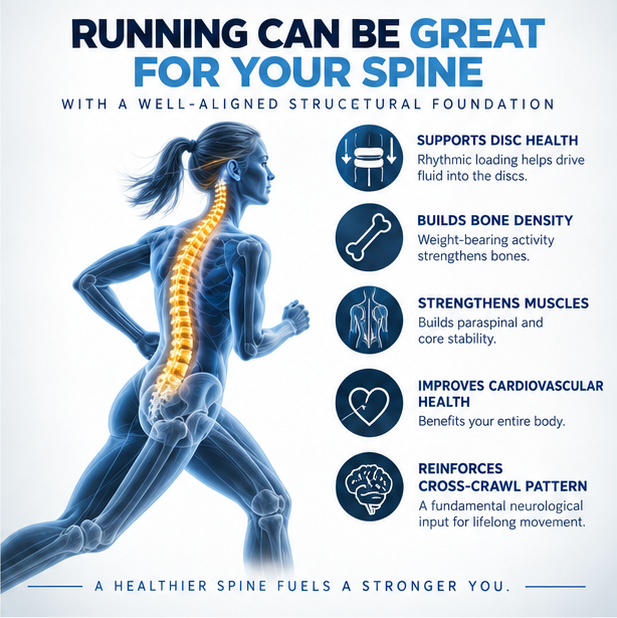
The caveat is that all of those benefits assume a reasonably well aligned structural foundation. Running is a high repetition, high impact activity. The average runner takes 1,500 steps per mile, and every one of those steps sends a ground reaction force up through the kinetic chain. If there is an underlying pelvic tilt, lateral spinal shift, reduced lumbar lordosis, or asymmetric leg loading pattern, a structural abnormality that produces little or no discomfort at rest can turn into a significant injury under the repetitive loading of a training cycle.
Common Running Injuries That Point to a Structural Problem
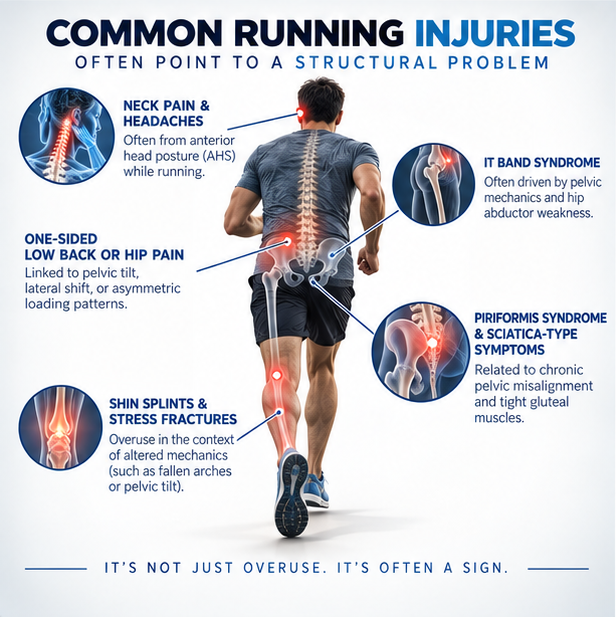
If your training isn't going as planned and any of the following keep showing up, they are typically not simple overuse problems, but rather signals pointing to a structural origin.
One-sided low back or hip pain while running
Pain that consistently appears on the same side, whether that's the left low back, the right hip, or one glute, reflects an asymmetric structural loading pattern. A lateral pelvic tilt from a leg length difference or a lateral trunk shift loads one side of the spine disproportionately with every step. This shows up because of the structural shift, whereas the running exacerbates it.
IT band syndrome
Iliotibial band syndrome, pain on the outer knee or outer thigh, is one of the most common running injuries and one of the most structurally driven. The IT band tightens in response to altered pelvic movement, which drives hip abductor weakness. A pelvic or lumbar misalignment, such as a reduced lumbar curve, changes how the gluteus medius fires, which changes how the femur tracks, which loads the IT band unevenly. Connective Tissue Restoration techniques on the IT band, like we perform in our initial phases of care, helps in the near term, but lasting relief requires correcting the underlying pelvic and lumbar alignment utilizing Precision Structural Correction techniques.
Piriformis syndrome and sciatica type symptoms
Deep gluteal pain, pain radiating down the back of the leg, or numbness into the foot during or after running often involves the gluteal muscles, particularly the piriformis, compressing the sciatic nerve. These muscles become tight and dehydrated as a result of chronic pelvic misalignment, which is why runners with sciatica type symptoms frequently don't improve with piriformis stretching alone.
Shin splints and stress fractures
Medial tibial stress syndrome and tibial stress fractures are overuse injuries, but overuse in the context of altered mechanics. Ask yourself why the femur or the ankle doesn't develop the same stress syndrome. Overpronation at the ankle, driven by fallen arches or a pelvic tilt, changes how impact force distributes through the tibia with every step. Running in unsupportive shoes on a structurally compromised foundation is a recipe for this kind of injury.
Neck pain and headaches during or after runs
This one gets overlooked as a running injury, but runners with Anterior Head Syndrome carry their head forward throughout the run, which puts the cervical spine under compressive load for the entire duration. The repetitive jarring of each step transmits directly into a cervical spine that's already loaded in a mechanically compromised position. Post-run cervicogenic headaches and upper neck tightness in runners are frequently structural in origin.
What to Do If Running Is Producing These Symptoms
Rest alone rarely solves a structurally driven running injury. It removes the load temporarily, but it doesn't change the mechanics that created the problem in the first place. If your training keeps getting interrupted by any of the patterns above, a complimentary consultation is a great next step.
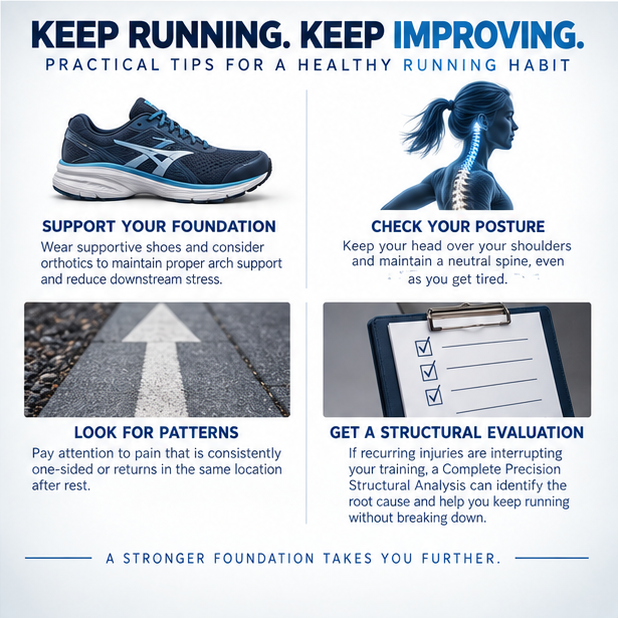
Pain that is consistently one sided, or an injury that returns to the same location after rest, is a sign that pushing through will likely cause further injury.
Supportive shoes and orthotics protect the shape of the arch and reduce the downstream effects when it collapses too much under repetitive loading.
Running form matters less than most runners assume, because every movement starts from, and returns to, your neutral alignment. Fix the foundation and the form tends to follow.
If training isn't going the way you planned and the same problems keep showing up, reach out. A Complete Precision Structural Analysis gives you the clearest picture of what your spine and pelvis are actually doing, and what needs to change so you can run without breaking down.
Call us at (412) 835-4844 or visit structuralchiropit.com to learn more. Tap the button below to schedule your complimentary consultation.