
What Dehydration Actually Does to Your Spine, and How to Stay Ahead of It
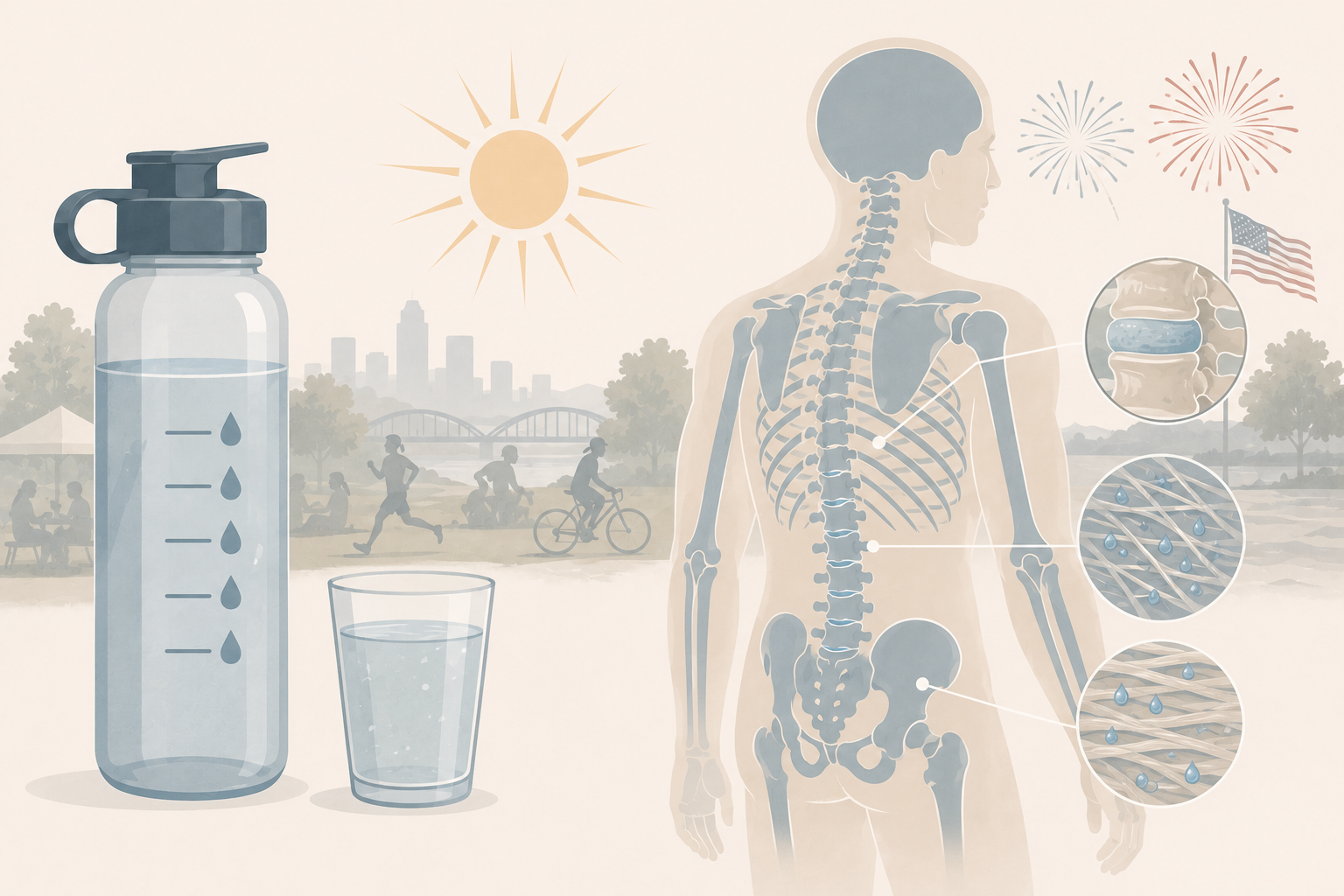
"Drink more water" is probably the most repeated health advice there is, and also the most ignored. But when it comes to your structural health specifically, dehydration is far more than feeling tired or getting a headache. It has direct, measurable consequences for your spinal discs, your fascia, and your body's ability to hold and respond to structural correction.
Here's what's actually happening when you're not drinking enough, and what to do about it.
Your Spinal Discs Are Mostly Water
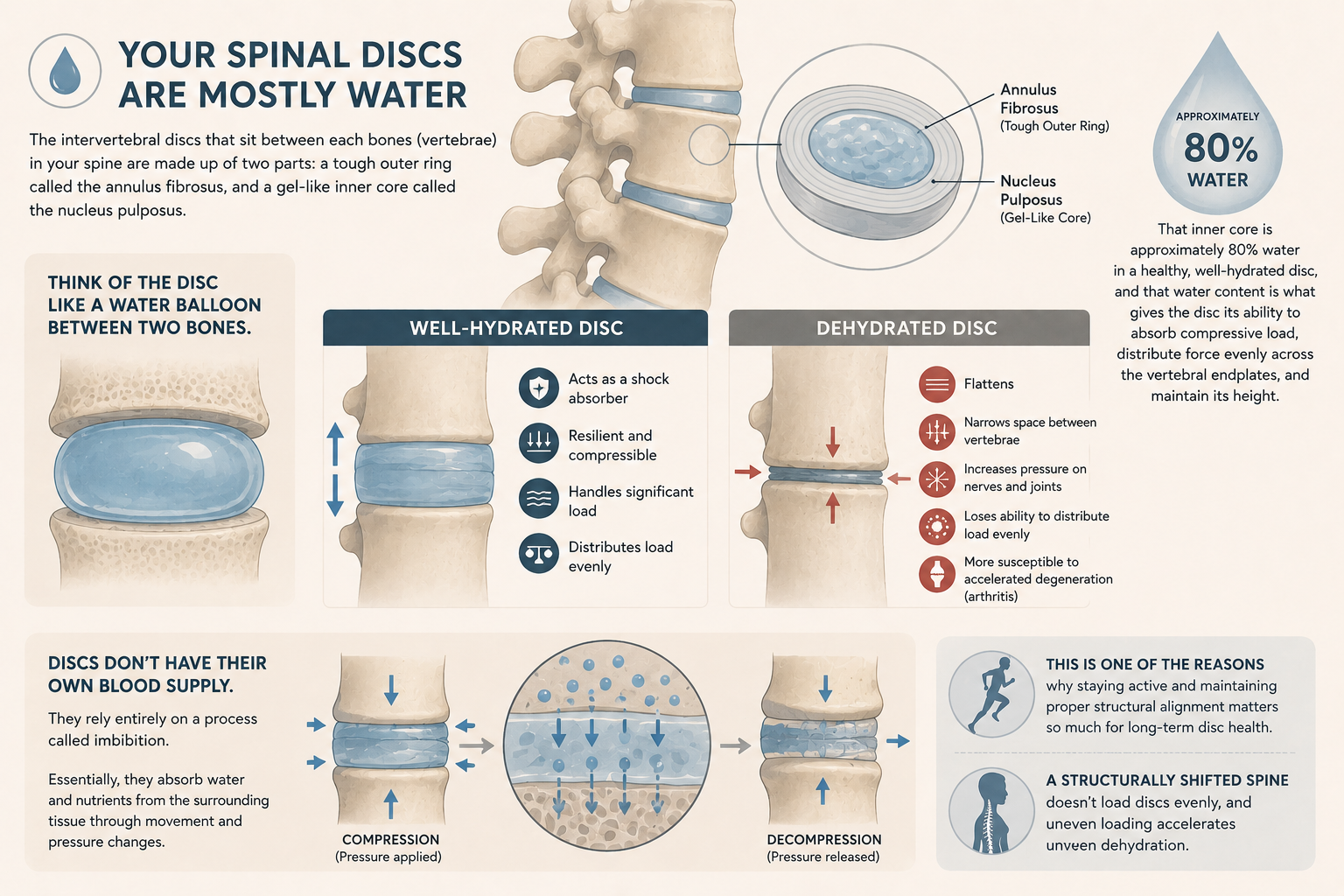
The intervertebral discs that sit between each vertebra in your spine are made up of two parts: a tough outer ring called the annulus fibrosus, and a gel-like inner core called the nucleus pulposus. That inner core is approximately 80% water in a healthy, well-hydrated disc, and that water content is what gives the disc its ability to absorb compressive load, distribute force evenly across the vertebral endplates, and maintain its height.
Think of the disc like a water balloon between two bones. When it's full, it acts as a shock absorber: resilient, compressible, and capable of handling significant load. When it's dehydrated, it flattens. A flattened disc narrows the space between vertebrae, increases pressure on the surrounding nerves and joints, and loses its ability to distribute load evenly. Over time, chronically dehydrated discs are far more susceptible to accelerated degeneration.
Here's the part most people don't know: discs don't have their own blood supply. They rely entirely on a process called imbibition, which is absorbing water and nutrients from the surrounding tissue through movement and pressure changes. This is one of the reasons why staying active and maintaining proper structural alignment matters so much for long-term disc health. A structurally shifted spine doesn't load discs evenly, and uneven loading accelerates uneven dehydration.
Fascial Dehydration
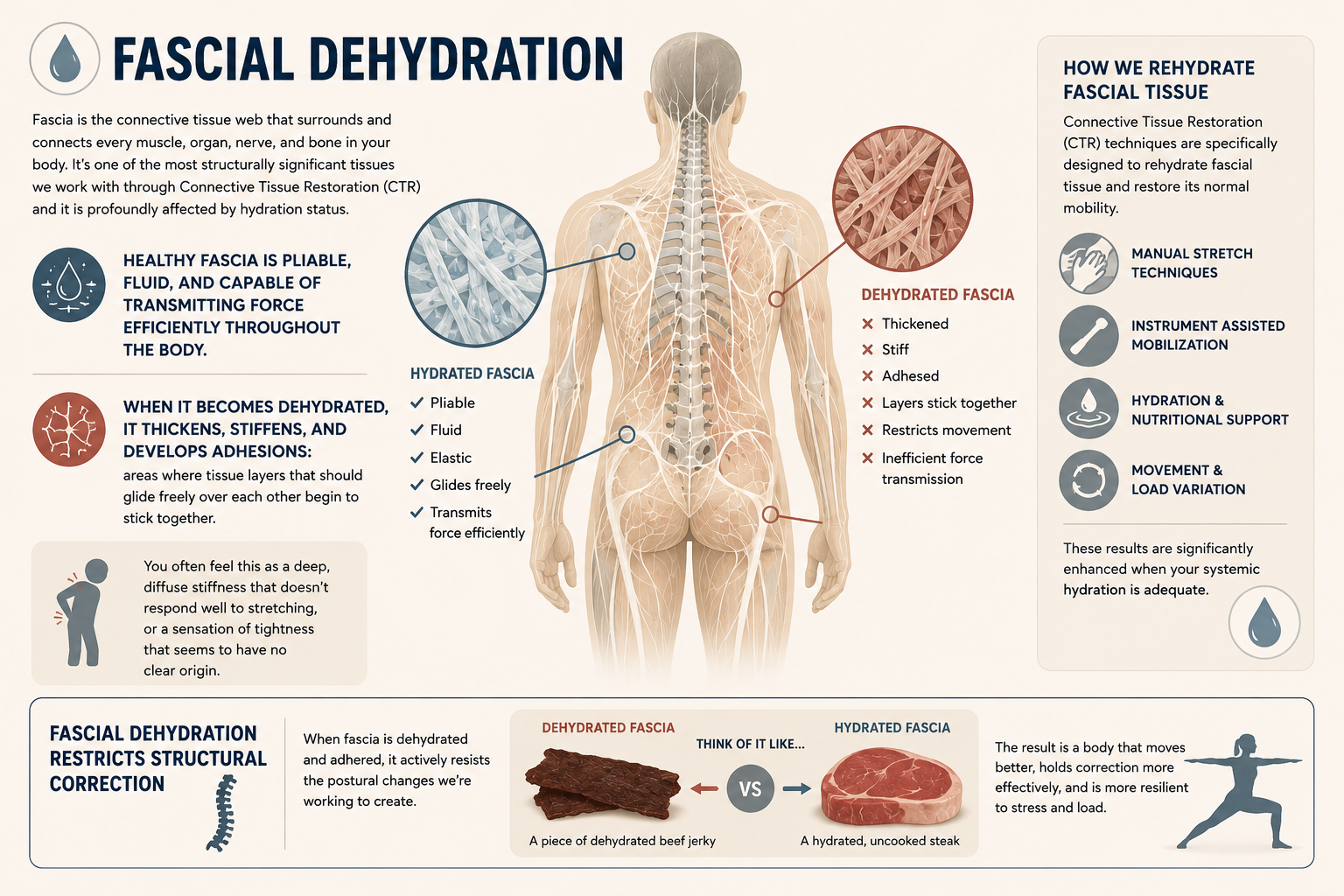
Fascia is the connective tissue web that surrounds and connects every muscle, organ, nerve, and bone in your body. It's one of the most structurally significant tissues we work with through Connective Tissue Restoration (CTR), and it is profoundly affected by hydration status.
Healthy fascia is pliable, fluid, and capable of transmitting force efficiently throughout the body. When it becomes dehydrated, it thickens, stiffens, and develops adhesions, areas where tissue layers that should glide freely over each other begin to stick together. You often feel this as a deep, diffuse stiffness that doesn't respond well to stretching, or a sensation of tightness that seems to have no clear origin.
Think of the difference between a piece of dehydrated beef jerky and a fresh, uncooked steak. That's the difference between dehydrated and hydrated fascia in terms of pliability, elasticity, and how well it responds to load.
Fascial dehydration restricts structural correction
When fascia is dehydrated and adhered, it actively resists the postural changes structural correction works to create. The Connective Tissue Restoration techniques we use in care plans are specifically designed to rehydrate fascial tissue and restore its normal mobility but those results are significantly enhanced when your systemic hydration is adequate.
How to Actually Stay Hydrated
Start before you're thirsty
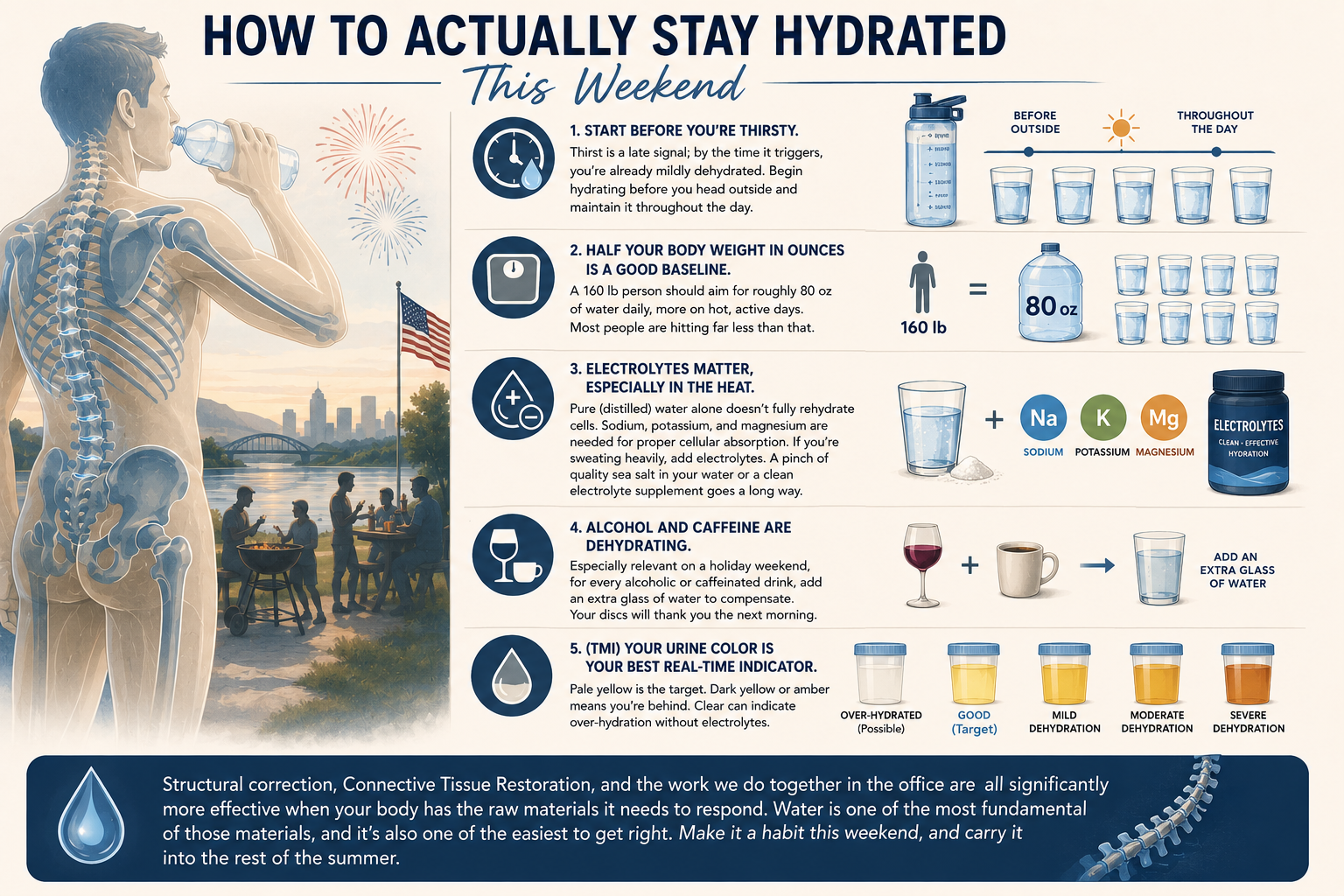
Thirst is a late signal. By the time it triggers, you're already mildly dehydrated. Begin hydrating before you head outside and maintain it consistently throughout the day rather than trying to catch up after the fact.
Half your body weight in ounces is a good baseline
A 160-pound person should aim for roughly 80 ounces of water daily and more on hot, active days. Most people are hitting far less than that without realizing it.
Electrolytes matter, especially in the heat
Pure water alone doesn't fully rehydrate cells. Sodium, potassium, and magnesium are needed for proper cellular absorption. If you're sweating heavily, add electrolytes. A pinch of quality sea salt in your water or a clean electrolyte supplement goes a long way toward actual rehydration rather than just fluid volume.
Alcohol and caffeine are dehydrating
For every alcoholic or caffeinated drink, add an extra glass of water to compensate. This is easy to overlook on active summer days when both are more likely to be in the mix. Your discs will reflect the difference the next morning.
Your urine color is your best real-time indicator
Pale yellow is the target. Dark yellow or amber means you're behind. Clear can indicate over-hydration without adequate electrolytes, which has its own consequences for cellular function.
Hydration and Your Structural Correction
Structural correction, Connective Tissue Restoration, and the work done in your care plan are all significantly more effective when your body has the raw materials it needs to respond. Water is one of the most fundamental of those materials, and it's also one of the easiest to get right.
If you have questions about how your daily habits like hydration, sleep, sunlight, or movement are supporting or limiting your structural correction progress, we’d be happy to help. Call us at (412) 835-4844 or tap the button below to schedule your complimentary consultation.