
Posture and Osteoporosis Fracture Risk: What to Know
This past Wednesday, I had the pleasure of speaking to a group at OsteoStrong's Pittsburgh South location. OsteoStrong's facility focuses on helping individuals with osteoporosis perform low-impact, osteogenic loading to build skeletal strength, improve balance, and support bone density. My presentation focused on the relationship between spinal structure, bone health, and long-term wellbeing, especially for people diagnosed with osteoporosis. Today, I want to share that same information with you.
Most of us were taught that posture is cosmetic, something your grandmother nagged you about. The research tells a very different story. Posture affects your quality of life. A 2015 study published in the European Spine Journal compared the quality-of-life burden of adult spinal deformity to four conditions we take very seriously, including arthritis, chronic lung disease, diabetes, and congestive heart failure, across nearly 25,000 people in eight countries. Depending on severity, these structural abnormalities matched or exceeded those conditions in quality-of-life impact.
What a Collapsing Structure Actually Does to the Body
The Framingham Heart Study followed thousands of adults for 16 years and found that as thoracic kyphosis, the rounding of the upper back, increased, lung function declined over time. The mechanics are simple. A compressed rib cage has less room to expand, so every breath becomes slightly harder than it needs to be. We demonstrated this live at the talk. Sit tall and take the deepest breath you can, then slump forward and try again. The difference is immediate and unmistakable. We covered this same mechanism in a previous blog post on forward head posture and breathing.
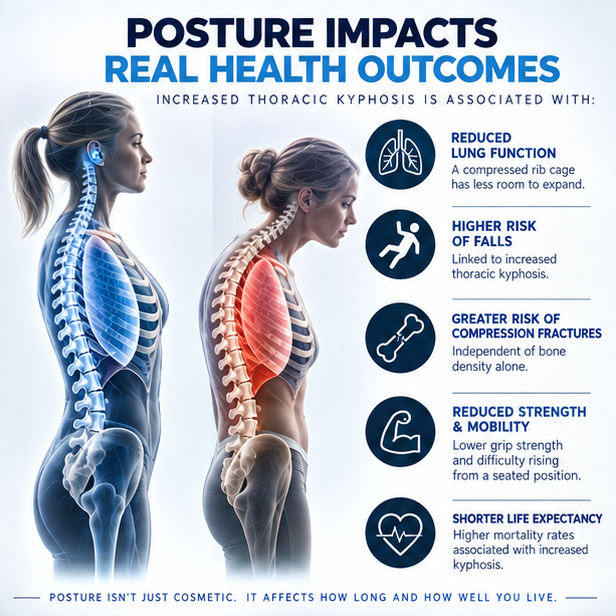
The Rancho Bernardo studies by Kado and Huang followed 1,883 adults presenting for osteoporosis care and found that those with that same increased rounding of the upper back, a hyperkyphotic posture, had measurably higher rates of injurious falls, osteoporotic compression fractures, reduced grip strength, difficulty rising from a seated position, and even shorter lives. Here is the part that matters most: all of these findings held true independent of bone density alone. Said differently, even if you have osteoporosis, you still have elevated risk if the structural scaffolding that bone sits within has shifted. Even strong bone inside a collapsing structure is still a fall waiting to happen. Bone density and structural alignment are truly complementary priorities for these populations.
None of This Is Permanent, Structure Responds to Correction
Here is what I want everyone to take from this. The research on structural decline is not a life sentence. It describes what happens when structural stress goes unaddressed, which means addressing it changes the trajectory. Bone, disc, and soft tissue remain biologically responsive throughout life. They adapted to the position you are in now, which means with a focused plan they can adapt to a better one. The same mechanism that allowed the problem to develop is the mechanism that allows it to correct.
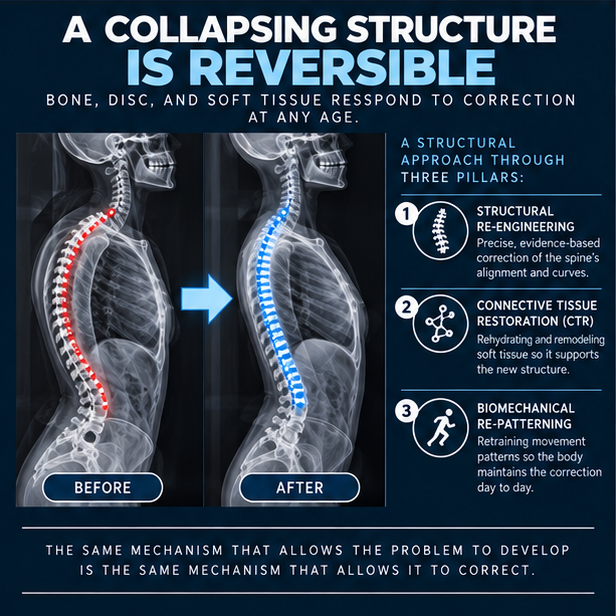
Precision Structural Correction approaches this through three pillars.
Structural Re-Engineering: Precise, evidence-based correction of the spine's alignment and curves.
Connective Tissue Restoration (CTR): Rehydrating and remodeling the soft tissue so it supports the new structure rather than pulling it back to the old one.
Biomechanical Re-Patterning: Retraining movement patterns so the body maintains the correction day to day. Progress is tracked with objective imaging at every stage.
Try This Right Now, The 60-Second Posture Check
We did this together at the OsteoStrong talk. Have a partner look at your posture from the side, using the image below as a guide.
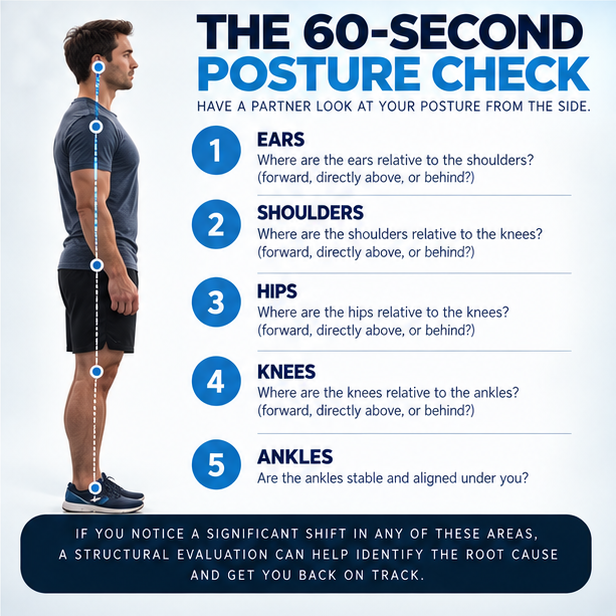
Ears. Where are the ears relative to the shoulders? Forward, directly above, or behind?
Shoulders. Where are the shoulders relative to the hips? Forward, directly above, or behind?
Hips. Where are the hips relative to the knees? Forward, directly above, or behind?
Knees. Where are the knees relative to the ankles? Forward, directly above, or behind?
Nobody is going to be perfectly aligned, but if you notice a significant shift in any of those regions, you likely have an underlying structural abnormality worth addressing. Remember, you are not stuck in the posture you have today. Every spine remains capable of change, and it is never too late to start standing taller, breathing easier, and moving through life with more strength.
Call us at (412) 835-4844 or visit structuralchiropit.com to learn more. Tap the button below to schedule your complimentary consultation.