
Fall Yard Work and Your Spine: What to Know Before You Pick Up That Rake

It's October in Pittsburgh, which means the leaves are coming down and the to-do list is going up. Raking, chopping firewood, cleaning gutters, and prepping the yard for winter are physically demanding in ways most people don't anticipate until something goes wrong. The combination of repetitive motion, awkward postures, sustained bending, and heavy lifting makes the transition from summer to fall one of the more structurally demanding times of the year. Here is how to think about each activity and what to watch for.
What Each Activity Does to Your Spine
Raking Leaves
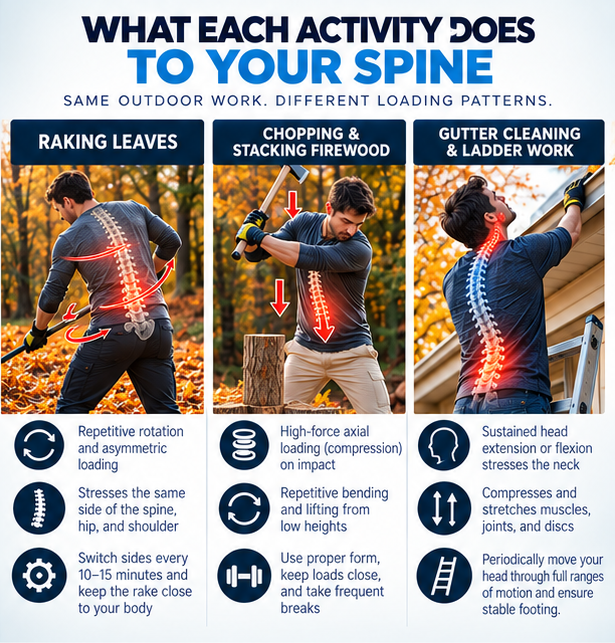
Raking, much like vacuuming, is deceptively demanding. Most people rake with a dominant side, which means the same shoulder leads, the same side rotates, and the same hip bears the load for hours at a time. That is asymmetric structural loading, and it directly compounds any existing lateral spinal or pelvic shift or rotation. To limit the strain, switch sides every 10 to 15 minutes, keep the rake handle close to your body, and avoid reaching far out in front. The farther the rake head sits from your center, the longer the lever arm pulling on your lumbar spine. Done with sound form, raking can also be a useful spinal exercise, so use the chore to your benefit.
Chopping and Stacking Firewood
Chopping wood also combines rotation, with the added effect of higher-force axial loading, or compression, through the spine on impact. Use the same concepts from raking to protect your spine and put the work to good use. Stacking firewood adds repetitive bending and lifting from low heights, and with improper form that is a reliable way to aggravate a lumbar disc. The best way to pick up smaller pieces of wood is the golfer's lift on one leg. For larger pieces, hinge at the hips rather than rounding your low back when setting logs down, much like a deadlift. Keep loads close to your body when carrying, and take frequent breaks the way you would during a workout, because that is what this is. The cumulative loading of a full cord of wood adds up faster than most people realize.
Gutter Cleaning and Ladder Work
Working overhead from a ladder creates a unique problem for the neck. Any sustained head and neck posture, whether your head is extended backward looking up or flexed forward looking down, can compress and stretch the muscles, joints, and discs of the cervical spine in an aggravating way. To limit that mechanical stress, periodically take your head through full ranges of motion. Look forward, backward, tilt side to side, and rotate left and right to redistribute the tension across different tissues. Most importantly, make sure your footing and your ladder are solid before you climb, to prevent a more serious injury.
Why Fall Injuries Feel Like They Come Out of Nowhere
The most common thing I hear after a fall yard work injury is some version of "I don't know what happened, I was just raking." These injuries feel sudden because the load that caused them built up over time. Fall outdoor work places different demands on the body than much of the summer, and often our structural system hasn't been primed for it.

Add an existing structural abnormality, such as forward head posture, a pelvic tilt, a lateral lumbar shift, or a reduced neck curve, and the threshold for injury drops significantly. Like a Jenga tower, the structure holds until one more repetition, one awkward reach, or one heavy lift tips the balance. These injuries come from the accumulation of repeated asymmetric loading on a compromised structural system, which is why early detection and correction play a critical role in preventing them.
A few simple habits go a long way this season. Switch sides regularly, lift with your hips, keep your head over your shoulders, take frequent breaks, and pay attention to what your body is telling you.
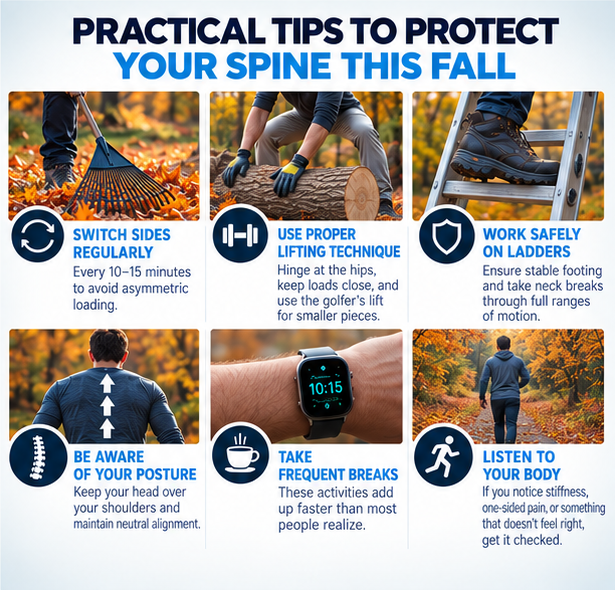
If fall yard work leaves you with stiffness, one-sided pain, or something that just doesn't feel right, don't wait it out. These signals are structural red flags worth addressing before they compound.
Call us at (412) 835-4844 or visit structuralchiropit.com to learn more. Tap the button below to schedule your complimentary consultation.