
Football and Your Spine: What Every Player, Parent, and Fan Should Know
Football season is officially back in Pittsburgh, and that means something different depending on where you are in life. Maybe you're a peewee parent lacing up cleats for the first practice. Maybe you're a high school lineman heading into two-a-days. Maybe you're a former player whose body still carries the structural consequences of years on the field. And maybe you're just a very dedicated fan whose couch posture during a three-hour game is its own structural event.
This week, across all of those groups, let's talk about football and structural health.
Why Football Is Structurally Unlike Almost Any Other Sport
The spine takes hits that no other sport replicates at scale.
Football involves repetitive high-impact collisions (helmet-to-helmet, helmet-to-body, body-to-ground) each of which sends compressive and shear forces through the cervical and thoracic spine in ways that accumulate over a season, a career, or a childhood. A single tackle may not cause an acute injury. But the same mechanism repeated hundreds of times per season, over years of play, creates a cumulative structural burden that can be significant even in the absence of a documented injury.
Football and Structural Health at Every Level
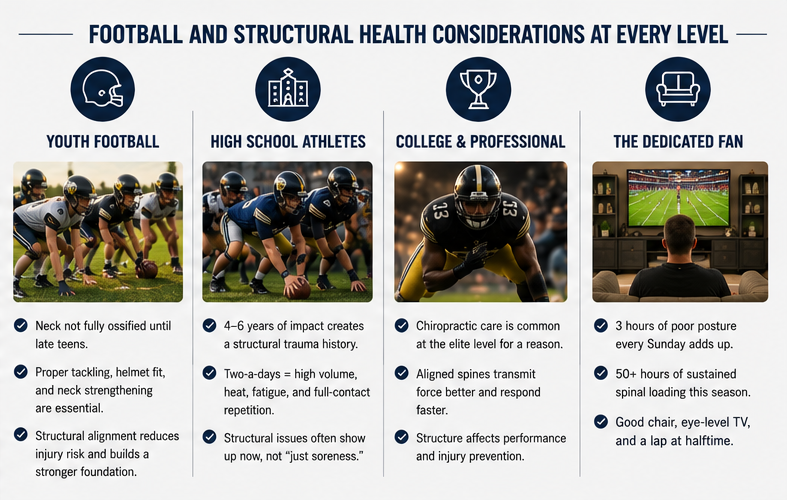
Youth football
The cervical spine doesn't fully ossify until the late teens. Young players are participating in a contact sport with a spine that is still structurally developing, meaning the same forces a mature adult spine might tolerate are being applied to a system with significantly different structural resilience. Proper tackling technique, helmet fit, and neck strengthening are the front line of protection. But what often goes unrecognized is that an underlying structural abnormality (such as a lateral shift, a reduced cervical curve, forward head posture) makes a young player significantly more vulnerable to injury from forces that might otherwise be manageable. A structurally evaluated and well-aligned young athlete is a more protected one.
High school athletes
By high school, a player who has been in the sport for four to six years has accumulated a structural trauma history, even without a single documented injury. Two-a-days in August are among the most structurally demanding weeks of the year: high volume, high heat, high fatigue, and full-contact repetition before the regular season begins. This is when existing structural abnormalities that were subclinical before typically become symptomatic. Parents and coaches often attribute the resulting pain and stiffness to soreness from conditioning. While sometimes that is true, sometimes it's the structural system demonstrating specific weak points.
College and professional
At the elite level, chiropractic care has a well-established presence. Most NFL teams have chiropractors on staff, and structural methods can be used specifically because the performance and injury-prevention rationale is compelling. A structurally aligned spine transmits force more efficiently, responds to dynamic loading more effectively, and is neurologically more capable. At this level, the difference between a well-aligned and poorly-aligned spine goes beyond pain and into how well the nervous system functions under elite physical demand.
The dedicated fan
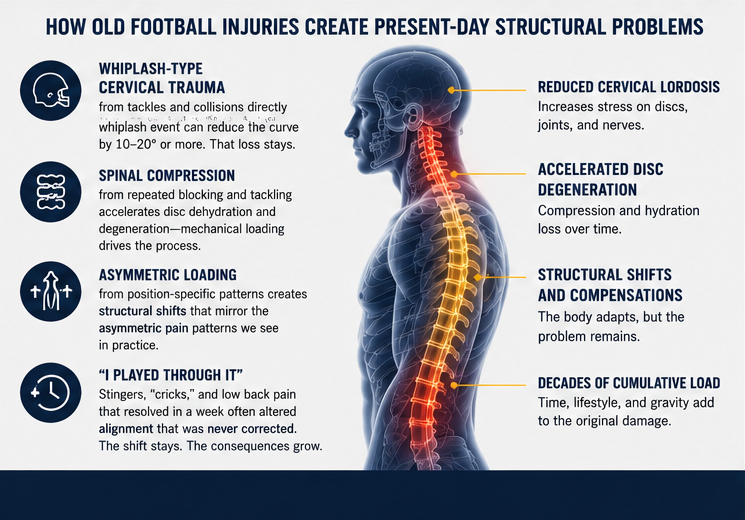
Three hours on a couch with your head craned toward a TV, shoulders rounded, lumbar spine flattened into flexion, repeated every Sunday from now through February, is a legitimate structural stressor. If you watch every game this season in a poor postural position, that's roughly 50 or more hours of sustained spinal loading in a compromised position. Get a supportive chair, put your screen at eye level, and take a lap at halftime.
How Old Football Injuries Create Present-Day Structural Problems
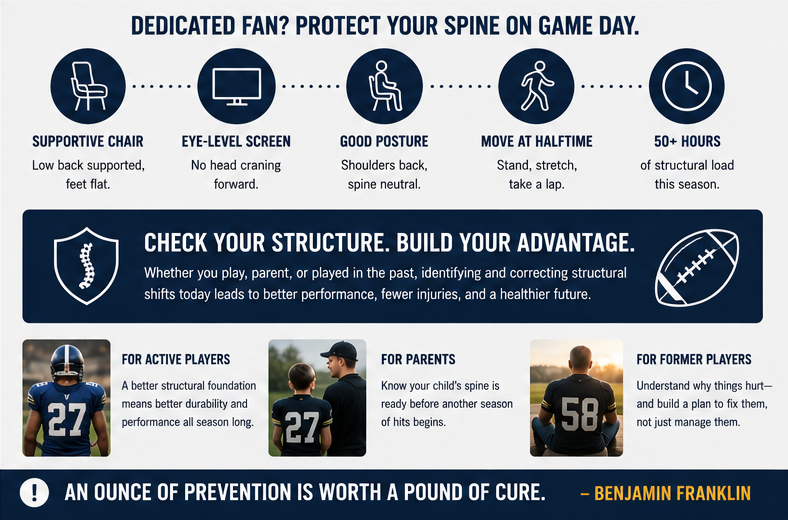
Whiplash-type cervical trauma
Tackles and collisions directly reduce cervical lordosis. Research on cervical acceleration-deceleration injuries shows that a single significant whiplash event can reduce the cervical curve by 10–20 degrees or more. That curve loss doesn't correct itself and it accumulates consequences over time.
Spinal compression
Repeated blocking and tackling accelerates disc dehydration and degeneration, the same process driven by mechanical loading rather than systemic dehydration. Former linemen often carry a disproportionate burden of lumbar disc pathology as a direct result of years of compressive loading.
Asymmetric loading
Position-specific movement patterns like quarterbacks rotating consistently to one side, running backs absorbing hits asymmetrically, kickers loading one leg explosively create structural shifts that mirror the asymmetric pain patterns seen in practice. The body adapts to the demands placed on it, but the underlying shift remains.
"I played through it"
The most common sentence heard from former players. A stinger, a crick in the neck after a hit, low back pain that resolved in a week. These structural events altered spinal alignment and were never addressed, the body compensated, which quieted the symptoms while the structural shift stayed. Decades later, that shift is still there, now compounded by time, lifestyle, and gravity.
What to Do About It
Whether you're a current player, a parent of one, or a former player carrying a structural history from years on the field, the approach is the same. Identify what has shifted, quantify it, and build a correction plan designed to restore as much of the normal structural architecture as possible.
For active players, that means a better structural foundation going into a season of contact. For former players, it often means understanding for the first time why certain things have hurt for years and having a sound plan to address them rather than managing them indefinitely. For parents, it means knowing whether your child's spine is where it needs to be before another season of hits begins.
If you've played football at any level and have never had a structural evaluation, not just a standard sports physical, but a Complete Precision Structural Analysis with radiographic assessment, this is the right time. What happened on the field doesn't stay on the field. Call us at (412) 835-4844, visit structuralchiropit.com, or tap the button below to schedule your complimentary consultation.