
EDS, Hypermobility, and Structural Chiropractic Care: What the Research Shows
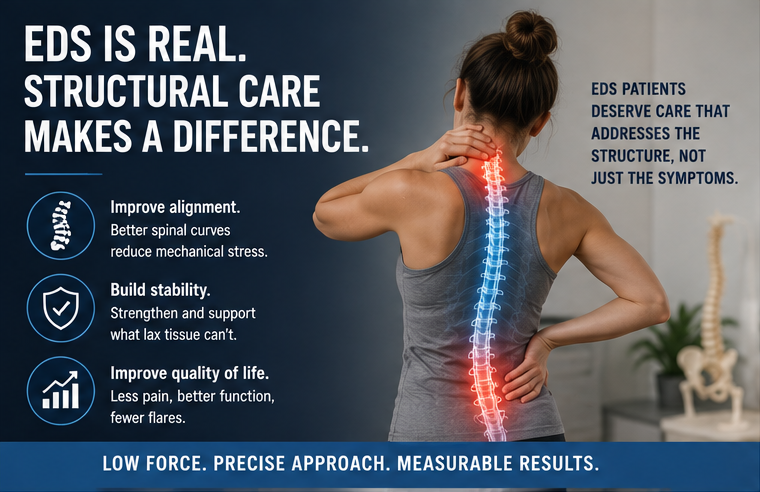
Over the past month, conversations about hypermobility have come up more than any other single topic in the practice. Whether from prospective patients, active patients, or their family members, questions about Ehlers-Danlos Syndrome (EDS) and hypermobility spectrum disorders keep surfacing. It's clearly something that has increased in prevalence, and awareness, and this week I want to address the questions directly.
The short answer is this: structural chiropractic care has a documented place in the management of hypermobility spectrum disorders, with important nuances, and there is peer-reviewed research to support it.
If this isn't directly relevant to you, it very likely is to someone you know. EDS and hypermobility spectrum disorders are significantly underdiagnosed. Many people spend years collecting symptoms and labels before anyone connects the dots. Please share this with anyone who might benefit.
What Is EDS?
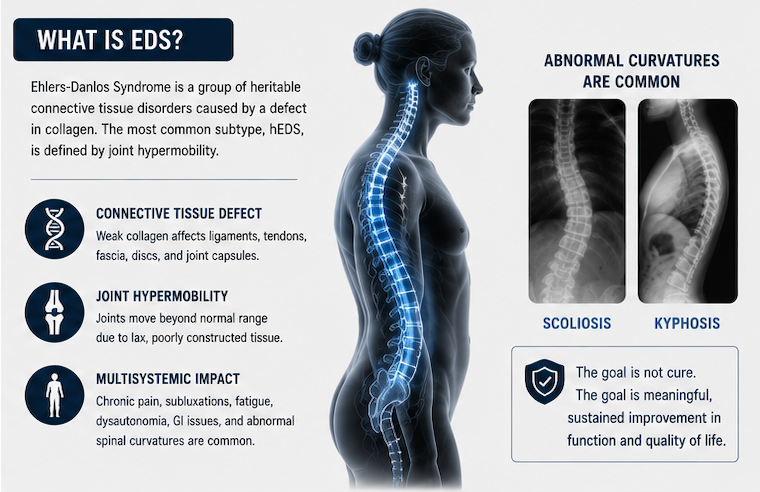
Ehlers-Danlos Syndrome is a group of heritable connective tissue disorders characterized by a defect in collagen synthesis; the same collagen that forms the structural scaffolding of ligaments, tendons, fascia, spinal discs, and joint capsules throughout the body. The most common subtype, hypermobile EDS (hEDS), is defined primarily by joint hypermobility: joints moving beyond their normal range of motion due to lax, poorly constructed connective tissue.
The clinical picture is often complex and multisystemic: chronic widespread pain, frequent joint subluxations or dislocations, fatigue, dysautonomia, gastrointestinal issues, and a spine that tends to develop abnormal curvatures including kyphosis and scoliosis. Many EDS patients have spent years in traditional healthcare settings being told their pain is disproportionate to their findings, or cycling through treatments that address symptoms without touching the underlying structural vulnerability.
Why conventional approaches often fall short
Conventional chiropractic care, the high-velocity thrust most people associate with chiropractic, is generally contraindicated for hypermobility patients. Adding motion to a joint system that already has too much of it is not the answer. This is one of the reasons EDS patients are often told that chiropractic care is not appropriate for them. But that advice conflates one technique with the entire profession.
Precision Structural Correction, focused on achieving postural and alignment change through low-force instrumented adjustment, specific traction, and postural rehabilitation, is a fundamentally different model. It is not about adding motion to hypermobile joints. It is about creating stability, improving spinal curves, and reducing the chronic mechanical stress that hypermobile connective tissue is uniquely vulnerable to.
The Research
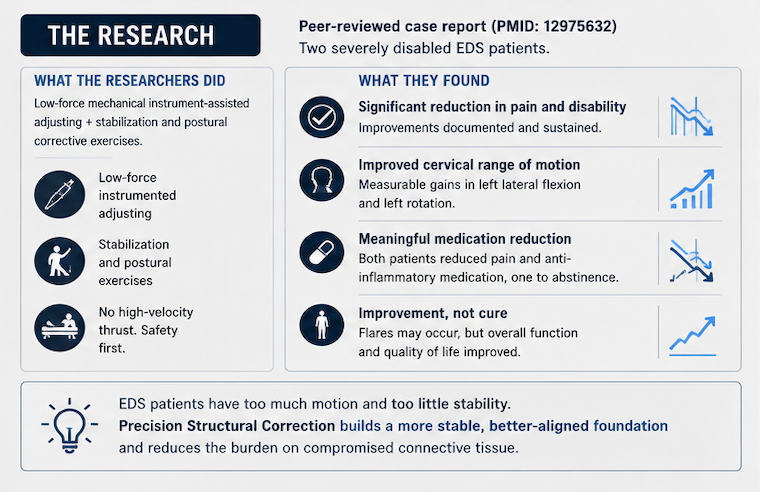
A peer-reviewed case report (PMID: 12975632) documents two severely disabled EDS patients who sought chiropractic care for disabling musculoskeletal pain including neck pain, back pain, headaches, and extremity pain. Both patients shared key structural findings: abnormal spinal curvatures, joint hypermobility, and connective tissue fragility. One had undergone prior surgical spinal fusion from T11 to the sacrum for scoliosis and osteoporosis. The other had significant forward head translation, a presentation very familiar in our practice.
Both patients were treated with a low-force mechanical instrument-assisted adjusting technique combined with stabilization and postural corrective exercises, a protocol intentionally selected to avoid the high-velocity thrusting that would be inappropriate for hypermobile joints.
What they found
Both patients experienced meaningful reductions in pain and disability over the course of care, and these improvements were sustained and documented through re-examinations. This is clinically significant because EDS patients are widely considered challenging to treat, with most conventional approaches producing only temporary symptom relief at best.
Re-examinations also documented measurable improvements in cervical range of motion, particularly left lateral flexion and left rotation, suggesting the structural and neurological environment of the cervical spine responded positively to the care protocol despite the underlying connective tissue disorder.
Perhaps most notably, both patients were able to reduce their pain and anti-inflammatory medication usage during and after care, in one case, to the point of abstinence from pain medication.
Realistic expectations: improvement, not cure
The authors note that EDS patients typically experience exacerbations throughout care, often triggered by activities of daily living rather than any specific traumatic event. The goal with this population is not cure. It is meaningful, sustained improvement in function and quality of life, reduction of the structural factors that amplify symptoms, and building a more stable structural foundation that reduces the frequency and severity of flares. The research is consistent with that picture.
Why Precision Structural Correction Makes Sense for This Population
EDS patients have too much motion and too little stability. Their connective tissue cannot adequately restrain joint movement, which means the spine is constantly at risk of being loaded in positions it cannot protect itself from. Every degree of forward head translation, every loss of cervical lordosis, every lateral spinal shift represents an additional mechanical burden that already-compromised connective tissue must manage.
Think of it like a building with weak steel, the composition of the structure itself is compromised, so getting the architecture as close to ideal as possible becomes even more important. A poorly aligned spine in a neurotypical patient is a problem. The same misalignment in an EDS patient, whose soft tissues cannot compensate as effectively, is a significantly greater burden.
Precision Structural Correction directly addresses that burden by using low-force instrumented adjustment, Mirror Image postural exercises, and specific spinal traction to improve spinal curves and reduce structural abnormalities. The goal is not adding motion, it is building a more stable, better-aligned structural foundation that places less demand on connective tissue that is already working overtime.
Signs That May Indicate Hypermobility
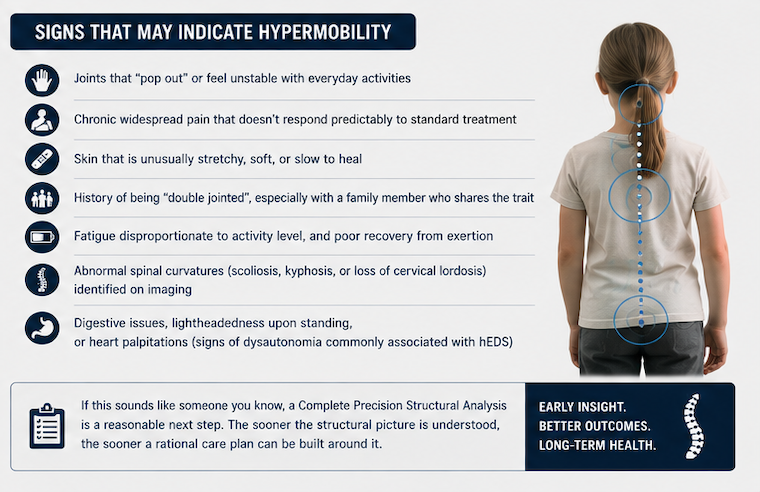
Many people with hypermobility spectrum disorders go undiagnosed for years. A few patterns to look for:
Joints that pop out or feel unstable with everyday activities.
Chronic widespread pain that doesn't respond predictably to standard treatment.
Skin that is unusually stretchy, soft, or slow to heal.
A history of being double jointed, especially with a family member who shares the trait.
Fatigue disproportionate to activity level and poor recovery from exertion.
Abnormal spinal curvatures (scoliosis, kyphosis, or loss of cervical lordosis) identified on imaging.
Digestive issues, lightheadedness upon standing, or heart palpitations, which are signs of the dysautonomia commonly associated with hEDS.
If this sounds like someone you know, a Complete Precision Structural Analysis is a reasonable next step. The sooner the structural picture is understood, the sooner a reasonable care plan can be built around it.
A Precise, Thoughtful Approach
EDS and hypermobility spectrum disorders are areas where the structural correction framework is uniquely well-suited, they require precision and intentionality rather than a one-size-fits-all approach. If this is something you or someone in your life is navigating, the conversation is always welcome.
The full study is available at PMID: 12975632 for anyone who wants to read it. To discuss your specific situation, call us at (412) 835-4844, visit structuralchiropit.com, or tap the button below to schedule your complimentary consultation.