
If You've Been Dealing With Dizziness, Your Neck May Be the Reason
Recently, a number of people have asked whether Precision Structural Correction can help with dizziness. Some had it as their primary complaint, others as something that comes and goes alongside neck pain or headaches they've always treated as separate issues. It comes up more than most people might expect, and the conversation almost always ends the same way: "Nobody has ever suggested my neck might be involved."
A study published August 16th, 2026 in the peer-reviewed journal Cureus speaks directly to this. If you or someone you know has been dealing with unexplained dizziness, what it found may change how you think about where to look for answers.
First: What Is Cervicogenic Dizziness?
Cervicogenic dizziness (CD) is dizziness that originates from the cervical spine, specifically from disrupted proprioceptive signaling, altered blood flow through the vertebral arteries, or neurological obstruction caused by structural abnormalities in the neck. It is distinct from inner ear disorders like BPPV or Meniere's disease, though it is frequently mistaken for them and treated accordingly, with little lasting success.
CD can be extremely debilitating. Reports of successful conservative treatment with sustained long-term results are, in the authors' own words, rare.
The Study
A 29-year-old woman presented with sudden-onset, debilitating cervicogenic dizziness and frequent syncope, she was actually losing consciousness, triggered by movements that extended the head and neck backward. She also reported neck pain, upper mid-back pain, and low back pain with significant disability. On radiographic evaluation, her cervical spine measured +9.4°, kyphotic, curving in the wrong direction entirely. Her condition had been worsening, and prior treatment had provided no lasting relief.
She underwent a 68-treatment CBP® orthopedic rehabilitation protocol over 5.5 months using three components that patients here will recognize: Mirror Image® postural exercises, postural adjusting, and Denneroll cervical traction, the same traction tool used in our office.
The results were striking. Cervical lordosis improved from +9.4° reversed to -16.4° in the correct direction, a change of nearly 26 degrees. Dizziness, syncope, neck pain, and back pain all improved during care. At the one-year follow-up, a full year after all treatment had ended, syncope was fully resolved, 90% of cervicogenic dizziness symptoms were gone, and cervical lordosis remained stable at -17.6°. As the structural correction held, the clinical outcomes held with it.
That is the structural difference.
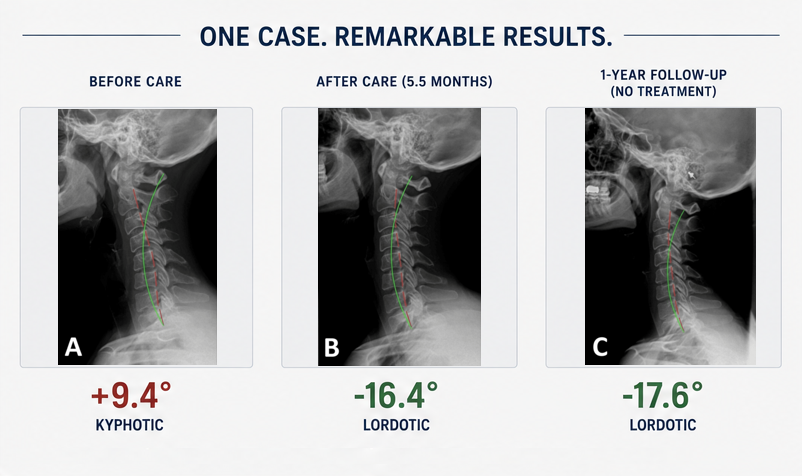
Cervical X-rays from Cureus case report (DOI: 10.7759/cureus.114624). A: Pre-treatment +9.4° kyphotic. B: Post-treatment -16.4° lordotic. C: One-year follow-up -17.6° lordotic.
Why This Matters
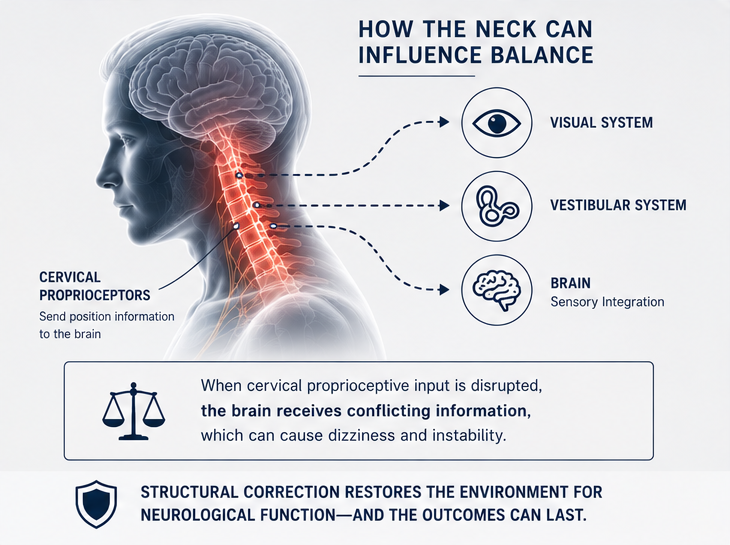
The cervical spine houses proprioceptors that tell the brain where the head is in space, the vertebral arteries that supply blood to the brainstem and cerebellum, and the upper cervical spinal cord itself. When the cervical curve is lost or reversed, all of these structures are placed under abnormal mechanical tension and compression. Proprioceptive signals become unreliable, vascular supply becomes compromised with certain head movements, and the result can be exactly what this patient experienced.
Restoring the cervical lordosis restores the mechanical environment for those neurological structures, which is why the outcomes in this case were so dramatic and durable. This is precisely why radiographic cervical curve measurement should be included in the evaluation of anyone dealing with persistent dizziness. The inner ear is not always where the answer is.
Signs That Dizziness May Have a Cervical Origin
Dizziness that worsens or is triggered with specific head or neck movements.
Dizziness that accompanies neck pain, upper back tightness, or frequent headaches.
Dizziness that has not responded to vestibular therapy or inner ear treatment.
A history of whiplash, concussion, or significant cervical trauma, even years ago.
Forward head posture, with the head sitting noticeably ahead of the shoulders when viewed from the side.
Dizziness that has been labeled unexplained or attributed to anxiety without a structural evaluation.
Any one of these warrants a closer look at the cervical spine. Several together make the structural connection difficult to ignore.
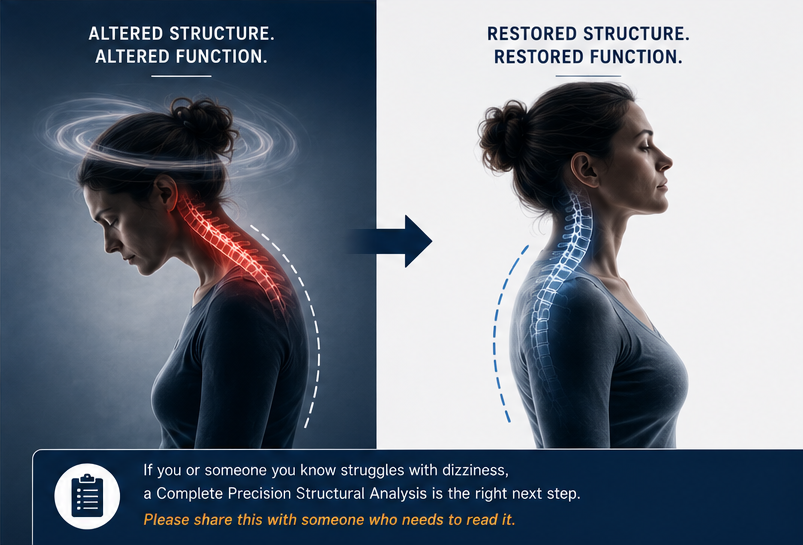
The cervical spine is a neurological relay station, and when its architecture is compromised, the signals it sends become unreliable. Precision Structural Correction restores the mechanical environment that neurological function depends on.
A Complete Precision Structural Analysis, including radiographic cervical curve measurement, is the appropriate next step for anyone in this picture. If this resonates with your situation or someone you know, please share it. This is one of the most underrecognized connections in musculoskeletal health.
The full study is published open-access in Cureus and available at DOI: 10.7759/cureus.114624. If this sounds like you, call us at (412) 835-4844, visit structuralchiropit.com, or tap the button below to schedule a complimentary consultation.