
Fall Sunlight in Pittsburgh: Your Updated Guide to Light Windows and Vitamin D
Back in June, around the Summer Solstice, we discussed how sunlight is one of the most underrated tools for structural and overall health. I covered how sunrise, UVA, UVB, and sunset each have distinct biological effects, and how Vitamin D deficiency and a disrupted circadian rhythm directly impair the body’s capacity to hold structural corrections. If you missed that article, I recommend reading the full summer sunlight post for context on what I cover here.
The Fall Equinox has passed, which means the Earth’s northern hemisphere is now tilting away from the sun and creating the colorful season we love in Pittsburgh. Since then, we have crossed an important threshold. We are losing roughly three minutes of daylight per day, and the biological consequences are significant enough to revisit. Here is what has changed and what to do about it.
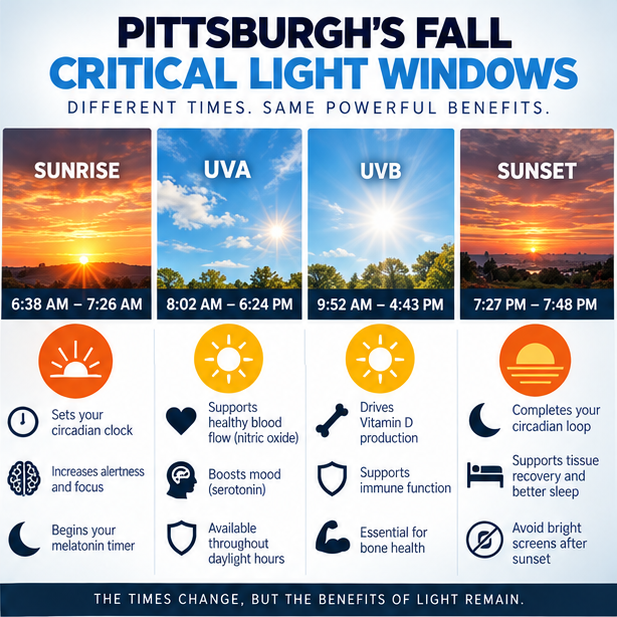
Pittsburgh’s Critical Light Windows, Updated for Fall
Sunrise: approximately 6:38 am to 7:26 am (it was 5:18 am to 5:51 am in June)
Morning light is still your most important circadian anchor, the signal that sets your clock. The low-angle red and near-infrared wavelengths at sunrise set your cortisol pulse for alertness, establish your energy and focus for the day, and begin the melatonin timer that builds sleep pressure for that night. The key difference in fall is that sunrise now arrives about 90 minutes later. If you wake before 7:26 am, you are waking before the light signal is available. Getting outside shortly after sunrise, even briefly, remains the single most important light habit in every season.
UVA: approximately 8:02 am to 6:24 pm (it was 6:54 am to 7:42 pm in June)
UVA rays trigger nitric oxide release for healthy vascular function, support serotonin production for mood regulation, and drive melanin buildup. They are less angle-dependent than UVB and remain available throughout daylight hours year round. The bigger factor in a Pittsburgh fall is cloud cover. October averages only about six hours of sunshine per day, which limits UVA exposure significantly compared to summer, so outdoor time on clear days becomes more valuable as we move into the colder months.
UVB: approximately 9:52 am to 4:43 pm (it was 8:42 am to 5:54 pm in June)
This is the most significant change from summer. UVB is the wavelength that drives Vitamin D synthesis in the skin, supporting bone density and immune and inflammation regulation, and it is only present when the sun is high enough in the sky. In Pittsburgh in October, that window runs roughly from 10 am to 4 pm and it closes further as the months progress. Even then, UVB intensity is substantially lower than in summer. At our latitude of about 40 degrees north, UVB is nearly negligible for Vitamin D production by late October. This marks the beginning of the annual Vitamin D deficit season that Pittsburgh experiences every fall and winter. If you have been primarily indoors this summer, your Vitamin D status has likely declined. You can build it again next year, and prioritizing midday sun exposure right now can help offset the gap.
Sunset: approximately 7:27 pm to 7:48 pm (it was 8:45 pm to 9:18 pm in June)
Sunset now arrives earlier every day and will keep moving earlier until the winter solstice in December. The evening low-angle light that completes the circadian loop and supports tissue recovery now happens around dinner time instead of late in the evening. That gives your nervous system the natural off-ramp it needs at a reasonable hour, if you let it. The challenge is that screens and artificial light after sunset directly fight the melatonin signal your body is trying to generate. Blue light blocking glasses are a great tool to keep from offsetting your circadian clock after dark. I personally wear and recommend BlueSafe 24.
Why the Fall Vitamin D Decline Matters for Your Structural Health
Pennsylvania sits at a latitude where meaningful UVB-driven Vitamin D synthesis is possible roughly from April through October, and we are at the end of that window right now. From November through March, outdoor time in Pittsburgh will not produce meaningful Vitamin D through the skin. What you accumulate in late spring, summer, and early fall is what your body draws on through the winter.
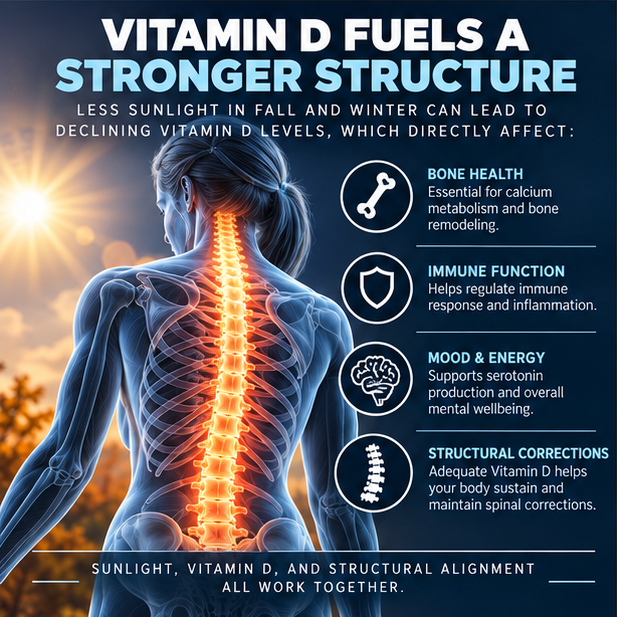
Vitamin D deficiency directly impairs calcium metabolism and bone remodeling, two processes your skeletal system depends on to sustain its structural integrity and for Precision Structural Correction to hold. It also affects immune regulation, mood, and inflammation modulation. The combination of less sunlight, less movement, more indoor time, and declining Vitamin D that defines a Pittsburgh fall and winter makes this one of the most structurally significant seasonal transitions of the year.
You may be wondering whether supplementation is the answer, or whether going outside at midday is even worth it with UVB dropping. Supplementation is a last resort, because your body naturally produces Vitamin D and a supplement does not replace that health benefit. With that said, if you are significantly deficient from limited sun exposure over the summer, it should be considered. As for getting outside at midday, the answer is yes. Light exposure has many other benefits, including the UVA effects we discussed above, so even in the dead of winter you should spend some time outside in each of the light windows every day.
What to Do Right Now to Improve Your Light Habits This Fall
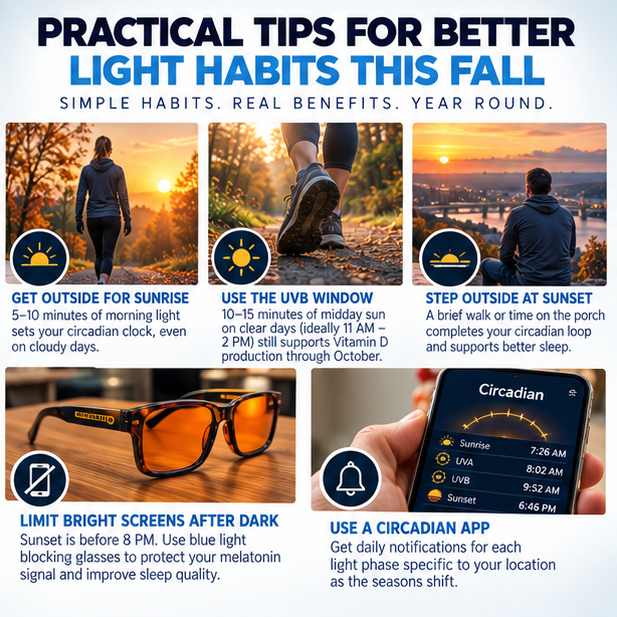
Get outside for sunrise. Five to ten minutes of outdoor morning light, even on overcast days, delivers enough signal to set your circadian clock. This habit matters year round, and especially in fall and winter.
Use the remaining UVB window. On clear days, 10 to 15 minutes of midday sun on your skin between 11 am and 2 pm is still meaningful for Vitamin D production through October. From November through March, consider supplementation if you missed this opportunity earlier in the year.
Step outside at sunset. The evening low-angle light that completes your circadian loop is arriving earlier and earlier. A brief walk or a few minutes on the porch around sunset costs nothing and pays dividends in your sleep quality.
Protect your evening from screens. With sunset before 8 pm, your melatonin signal begins earlier. Bright screens and overhead lighting after dark suppress it. Blue light blocking glasses are a great tool for enjoying your Sunday Night Football and the sleep that follows.
Use the Circadian app. It provides daily notifications for each light phase specific to your location and updates in real time as the seasons shift. As the windows narrow, the precision matters more.
Sunlight, sleep, and structural alignment all work together. If you have questions about how your seasonal health habits connect to your correction plan, bring them to your next visit.
Call us at (412) 835-4844 or visit structuralchiropit.com to learn more. Tap the button below to schedule your complimentary consultation.