
Why Sunlight Is One of the Most Powerful Things You Can Do for Your Health This Summer
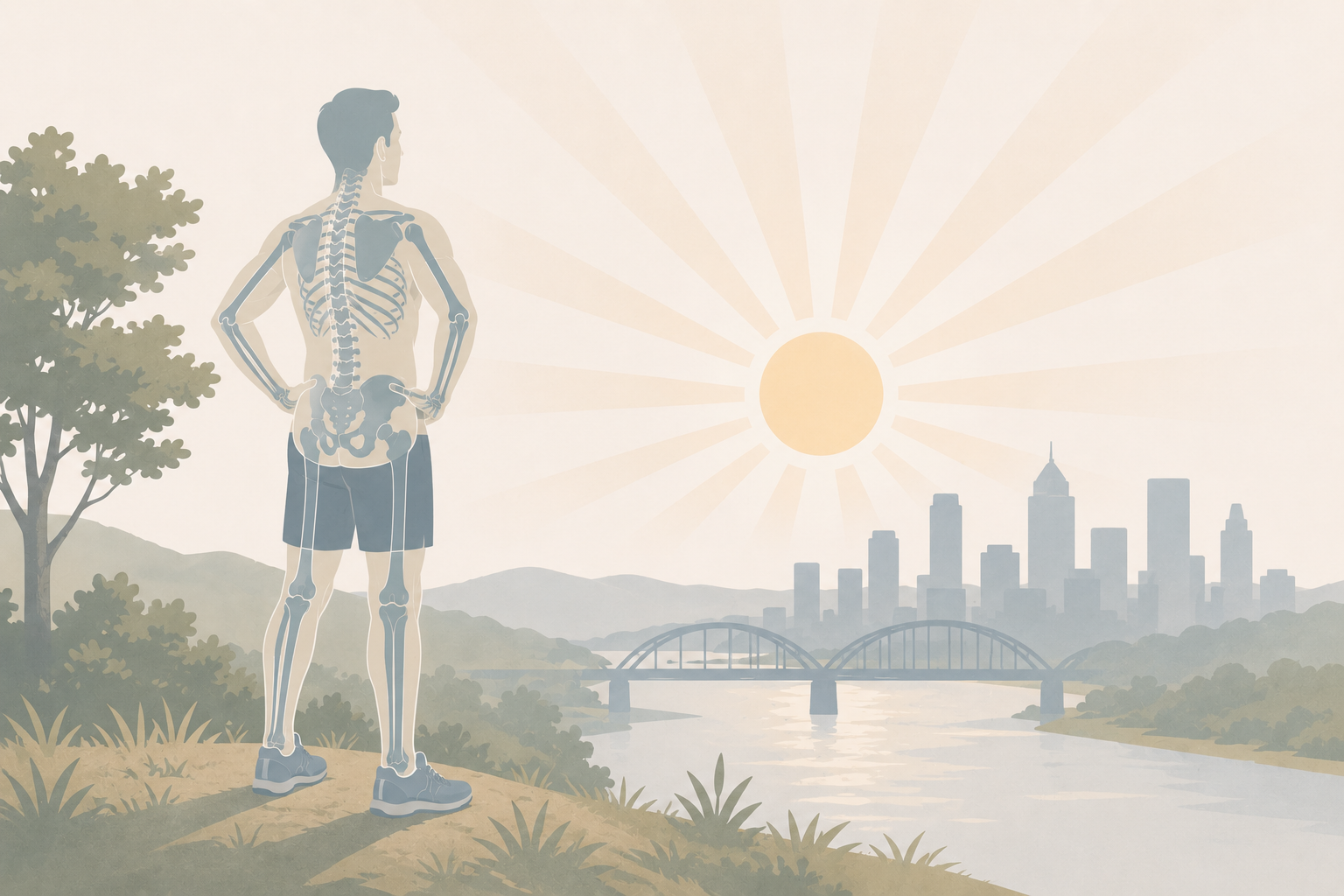
Overall health and wellness isn't built by any singular habit. It's the combination of what we eat, how we move, how we sleep, how we connect with others, and how well our structure supports all of it. This week I want to talk about something that directly supports the body's ability to heal, regulate, and function at its best, and that most of us are significantly underexposed to: sunlight.
The Summer Solstice is the longest day of the year, and while some treat it as a calendar footnote, it's actually one of the most meaningful reminders of the year from a health standpoint. The amount and quality of sunlight your body receives has a profound effect on your biology. Understanding what each type of light does, and when to get it, is one of the simplest and most powerful things you can do for your health this summer.
Why Sunlight Is an Essential Nutrient Throughout the Day
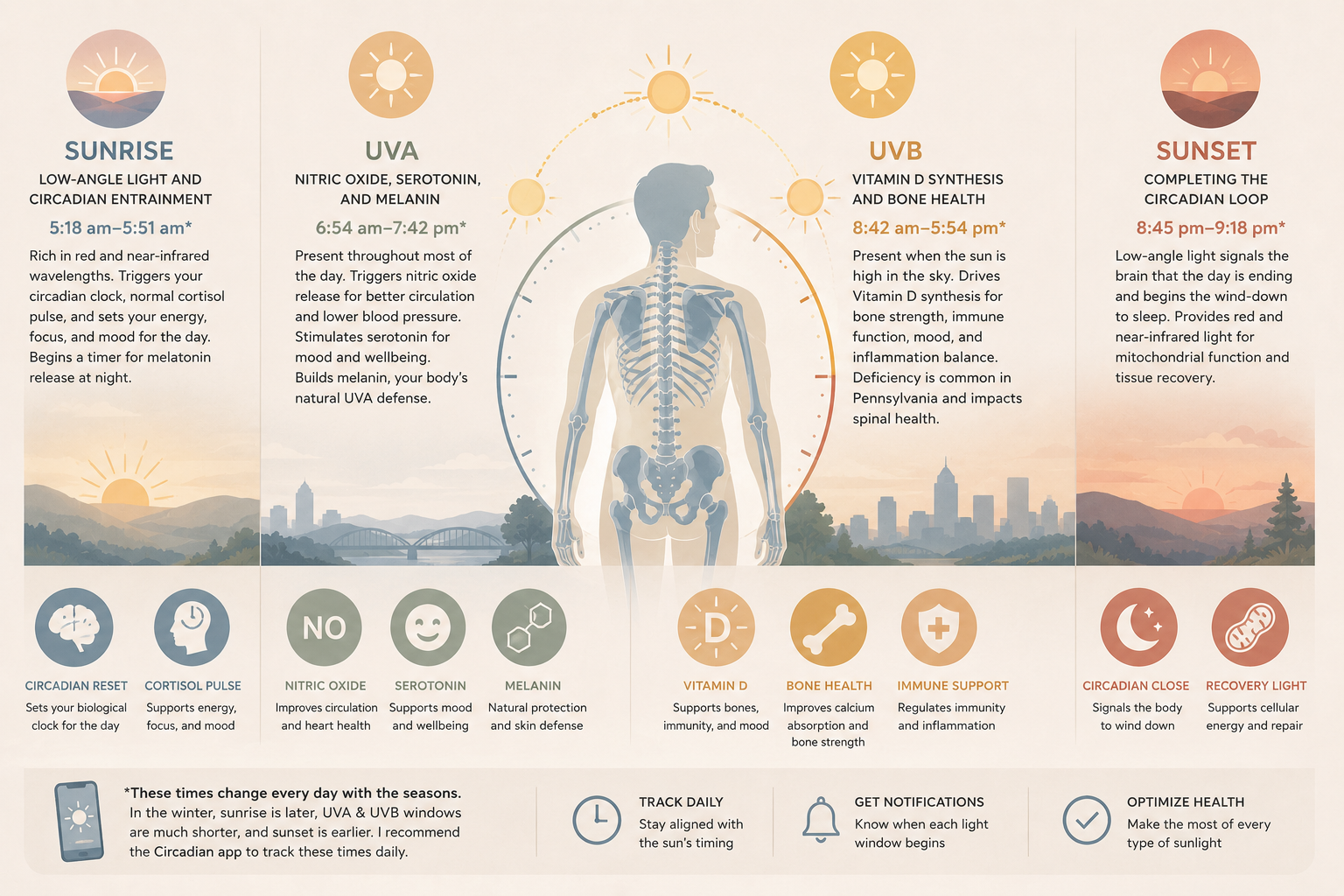
It’s critical to realize that much like a proper meal has multiple ingredients. Similarly, sunlight isn't one single type of light but a combination of many different wavelengths each with distinct biological effects. Just as importantly, the composition of that spectrum changes as the sun moves across the sky throughout the day. Here's what that means in practice.
Sunrise: Low-angle light and circadian entrainment
The first light of the morning, before the sun clears the horizon, is rich in red and near-infrared wavelengths. Getting outside within 30–60 minutes of sunrise and allowing that low-angle light to reach your eyes by simply being outside, is one of the most powerful signals you can send your circadian clock. It triggers a normal cortisol pulse that sets your energy, focus, and mood for the entire day, and begins a timer that determines when melatonin releases that night for deep sleep. Think of it as your body's daily calibration, no different than setting your watch in the morning.
UVA: Nitric oxide, serotonin, and melanin
UVA rays are present throughout most of the day and penetrate deeper into the skin than other wavelengths. UVA exposure triggers the release of nitric oxide, a vasodilator that lowers blood pressure, improves circulation, and supports cardiovascular health. It also stimulates serotonin production in the skin, contributing directly to mood regulation and a sense of wellbeing. Melanin, the pigment that gives skin its tan, is the body's natural UVA defense, produced in response to cumulative sun exposure. It's a sophisticated photoprotective system your body builds gradually over the course of the year.
UVB: Vitamin D synthesis and bone health
UVB rays are present primarily when the sun is high in the sky, and this is the wavelength that drives Vitamin D synthesis in the skin. Vitamin D plays a direct role in calcium absorption and bone density, immune regulation, mood, and inflammation modulation. Vitamin D deficiency is extraordinarily common in Pennsylvania given our long winters and predominantly indoor lifestyles, and it has direct implications for spinal health and the body's capacity to respond to structural correction. One important note: even at solar noon, when the sun is at its highest point in the sky, red, infrared, and near-infrared wavelengths still make up more than 50% of the sunlight you're receiving.
Sunset: Completing the circadian loop
Just as morning light sets the circadian clock, evening low-angle light helps complete it. Viewing the sunset, or simply being outdoors in the hour before dark, signals the brain that the day is ending and begins the wind-down sequence toward sleep. It also provides a second dose of red and near-infrared light, which supports mitochondrial function and tissue recovery. In a world full of artificial blue light from screens after dark, the sunset gives your nervous system a natural off-ramp.
One important caveat: these timing windows are based on your latitude and they change every day with the seasons (so what you see in the image is for Pittsburgh, PA on Summer Solstice). In winter, sunrise is later, UVA and UVB windows are significantly shorter, and sunset comes earlier. If you want to track these windows precisely, the Circadian app provides daily notifications for each light phase.
Sunlight and Structural Health
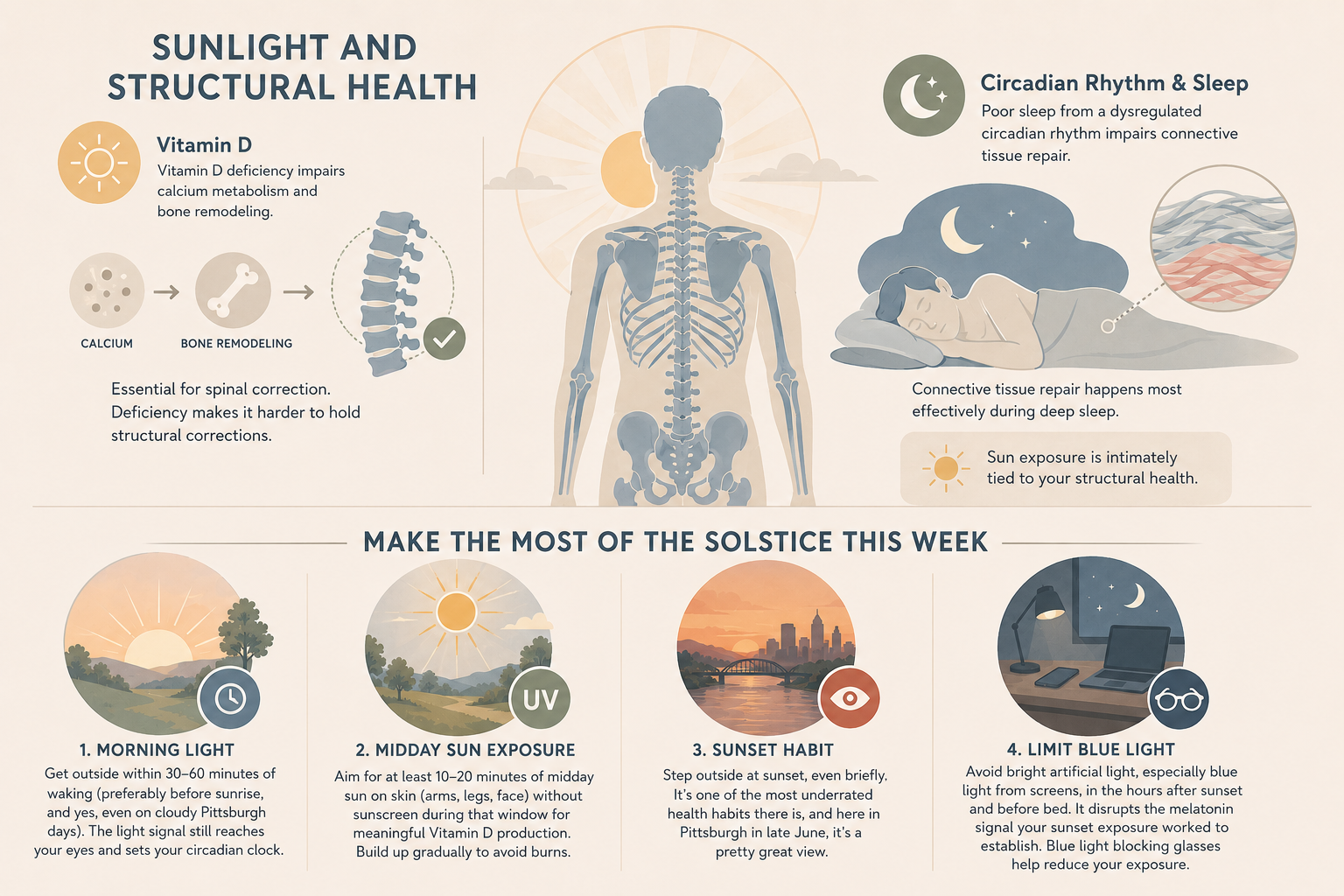
The connection between sunlight and structural health is more direct than most people realize.
Vitamin D deficiency directly impairs calcium metabolism and bone remodeling, two processes that are essential for the structural correction work we do together. Patients who are chronically deficient often have a harder time holding structural corrections because the skeletal system lacks the raw materials it needs to remodel effectively.
Beyond that, poor sleep from a dysregulated circadian rhythm impairs connective tissue repair. The fascial rehydration and Connective Tissue Restoration work that happens during your care is most effective when it's supported by deep, restorative sleep.
How to Make the Most of the Light This Summer
You don't need a complicated protocol. A few simple habits compound meaningfully over time.
Get outside within 30–60 minutes of waking (preferably around sunrise, and yes, even on cloudy Pittsburgh days). The light signal still reaches your eyes and sets your circadian clock even through overcast skies. Aim for at least 10–20 minutes of midday sun exposure on skin (arms, legs, face) without sunscreen during the UVB window for meaningful Vitamin D production. Build up gradually to avoid burns; the goal is consistent exposure, not intensity.
Step outside at sunset, even briefly. It's one of the most underrated health habits available, and here in Pittsburgh in late June, it happens to come with a pretty exceptional view. And in the hours after sunset, avoid bright artificial light, especially blue light from screens, before bed. It disrupts the melatonin signal your sunset exposure worked to establish. Blue light blocking glasses are a practical tool for reducing that exposure if screens after dark are unavoidable.
As the old proverb goes, the best time to plant a tree was twenty years ago. The second best time is today.
Sunlight, Sleep, Movement, and Structure
Health is built one good habit at a time, and sunlight, sleep, movement, and structural alignment all work together toward the same outcome. If you'd like to talk about how your structural correction plan supports the bigger picture of your health, we'd love that conversation. Tape the button below to schedule your complimentary consultation.