
Your Spine and Your Joints Are Connected: A Structural Guide to Extremity Care
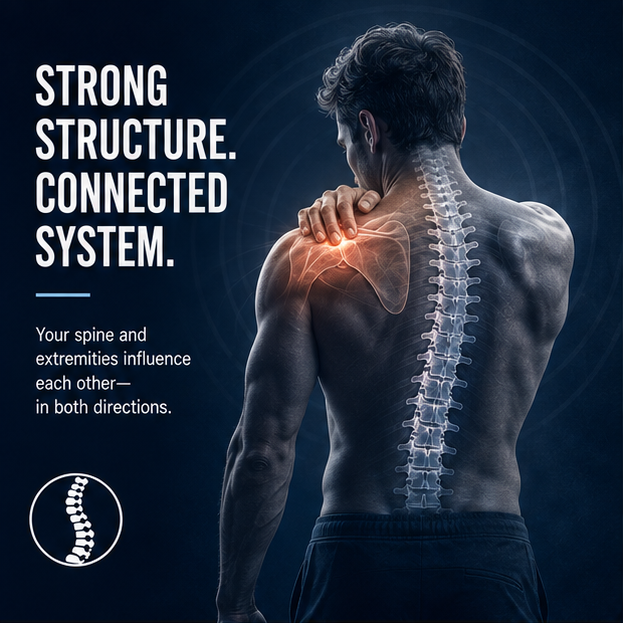
Most patients understand our practice focuses heavily on spinal structure and posture. What doesn't always come up, until a patient mentions it almost as an aside, is the shoulder that's been nagging for months, the knee that's been stiff since a sprain years ago, or the wrist that never quite felt right after an injury. It's often brought up with a qualifier: "I assumed that wasn't something you could help with."
This week I want to clear up that misunderstanding and explain why extremity complaints and spinal structure are far more connected than most people realize, and why the relationship runs in both directions.
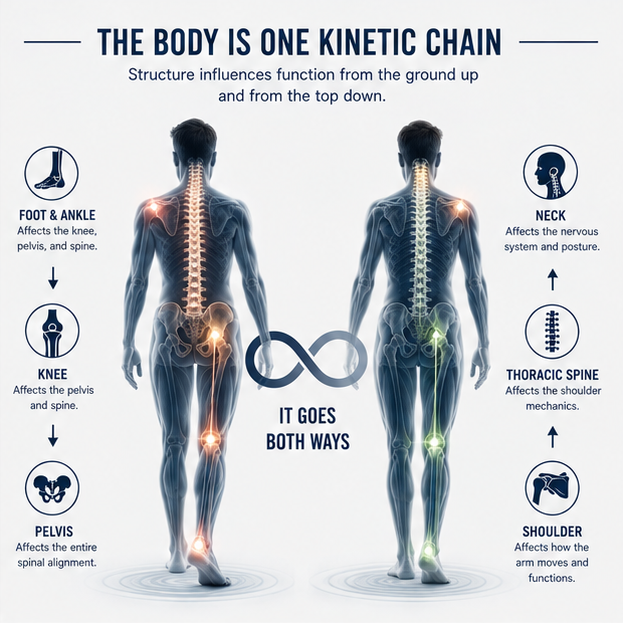
The Body Is One Kinetic Chain
Structure influences function from the ground up and from the top down.
Throughout this summer we've covered how foot mechanics affect the pelvis, how the pelvis affects the lumbar spine, and how the cervical spine affects the nervous system all the way down to the lumbar nerve roots. The same principle applies in every direction. A shoulder that sits forward and internally rotated doesn't just cause shoulder pain, it pulls the thoracic spine into increased kyphosis, which compounds Anterior Head Syndrome (forward head posture). A chronically pronated ankle doesn't just cause foot discomfort, it shifts the knee, tips the pelvis, and creates asymmetric structural loading throughout the lumbar spine.
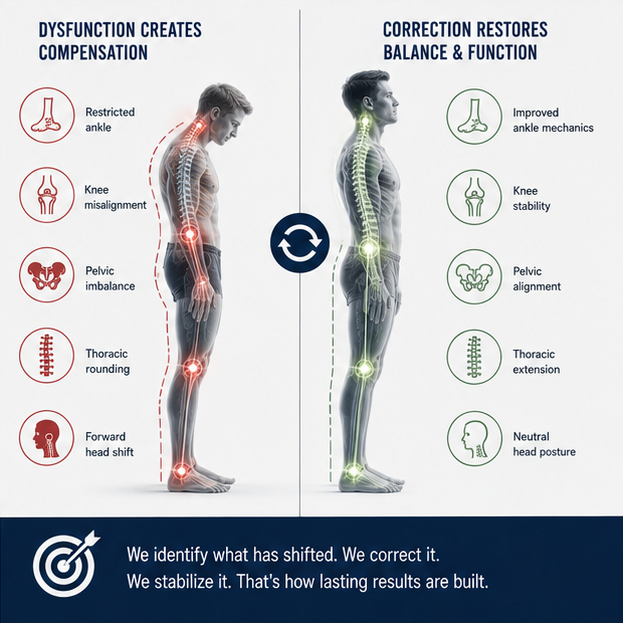
The kinetic chain means that a misaligned or restricted joint anywhere in the body creates a compensatory pattern that travels both up and down the chain. Addressing extremity joints while leaving a dysfunctional spine unaddressed is like straightening a picture frame on a wall that's still leaning, the underlying problem keeps expressing itself. Likewise, leaving extremity dysfunction unaddressed can have unintended consequences on the spine. For some patients, the extremity is the missing piece of their correction puzzle.
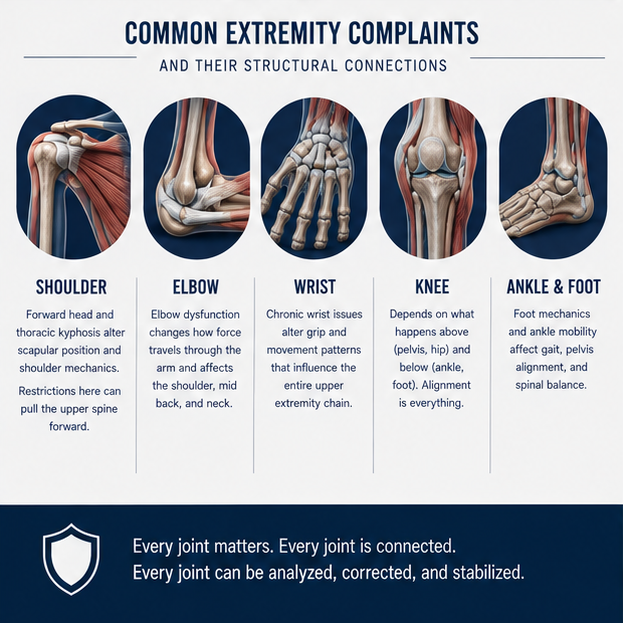
Common Extremity Complaints and Their Structural Connections
Shoulder pain
The shoulder joint has the greatest range of motion of any joint in the body, which also makes it the most vulnerable to positional dysfunction. Forward head posture and thoracic kyphosis, two of the most common structural abnormalities seen in practice, directly alter the resting position of the scapula and the mechanics of the glenohumeral joint. Many cases of rotator cuff irritation, impingement, and chronic shoulder tension have a postural and structural component that doesn't resolve with local treatment alone, because the source of the altered mechanics is upstream in the thoracic and cervical spine. Conversely, a shoulder that is restricted or mal-positioned limits full thoracic movement and creates asymmetric loading in the upper spine. It's a bidirectional relationship.
Elbow pain and wrist pain
A chronically restricted elbow or wrist, perhaps from golfer's elbow, tennis elbow, or carpal tunnel syndrome, alters how force is transmitted through the entire upper extremity during pushing, pulling, and carrying, which changes how the shoulder, mid-back, and neck move. Someone who has been unconsciously protecting a sore wrist for months, gripping differently and avoiding certain movements, has almost certainly developed a compensatory pattern that extends well above the wrist. If elbow or wrist complaints keep returning despite rest and bracing, the joint mechanics, and everything above them, are worth evaluating.
Knee pain
Because of the knee's “screw-home mechanism”, when standing still, its mechanical stresses depend almost entirely on what happens above and below it. Pelvic rotation or a leg length inequality creates uneven loading across the medial and lateral compartments of the knee, which is why knee pain is often one-sided and persistent even after local treatments. Similarly, ankle pronation causes tibial internal rotation, which places the knee in a mechanically compromised position with every step.
Ankle pain and foot pain
A single ankle sprain that was never fully rehabilitated can leave a subtle but persistent restriction that contributes to low back and hip asymmetry for years afterward. It is critical to restore proper ankle alignment, in addition to mobility, following these injuries. The ankle is the first link in the kinetic chain from the ground up, and what's left unresolved there rarely stays contained to the ankle.
How Extremity Care Fits Into Precision Structural Correction
When assessing and working with an extremity joint, the approach mirrors the same philosophy applied to the spine: identify what has shifted or restricted, understand how it is affecting the broader structural system, and apply specific corrective input to restore normal mechanics. This includes joint-specific assessment, low-force hands-on or instrument-assisted adjustment where appropriate, and targeted corrective exercises to stabilize the change.
The extremity is never treated in isolation. Every joint finding is evaluated in the context of the full structural picture because that is where the clinical significance lives. A restricted right shoulder means something different in a patient with a left thoracic shift than in one whose thoracic spine is well-aligned. Context is everything.
Mention at Your Next Visit
If any of these sound familiar, bring it up. It very likely isn't outside the scope of what we address here, and it may be more connected to the structural picture than you'd expect.
A shoulder that catches, clicks, or aches with overhead movement. Elbow or wrist pain that comes back despite rest and bracing. Numbness or tingling into the hand or fingers. A knee that has never felt quite right after a sprain or surgery. Chronic ankle stiffness or a history of repeated sprains on the same side. Any joint complaint you've been managing around and assuming isn't something we can help with.
One Connected System
The spine and the extremities are not separate clinical categories. They are one continuous structural system, and dysfunction anywhere in that system has consequences everywhere else. Identifying what has shifted, correcting it, and stabilizing the change is how lasting results are built, whether the starting point is the spine or a joint that's been nagging for years.
If you have a joint complaint you've been managing around, we'd welcome the conversation. Call us at (412) 835-4844, visit structuralchiropit.com, or tap the button below to schedule your complimentary consultation.