
Why Your Neck May Be the Reason Your Low Back Pain Won't Go Away
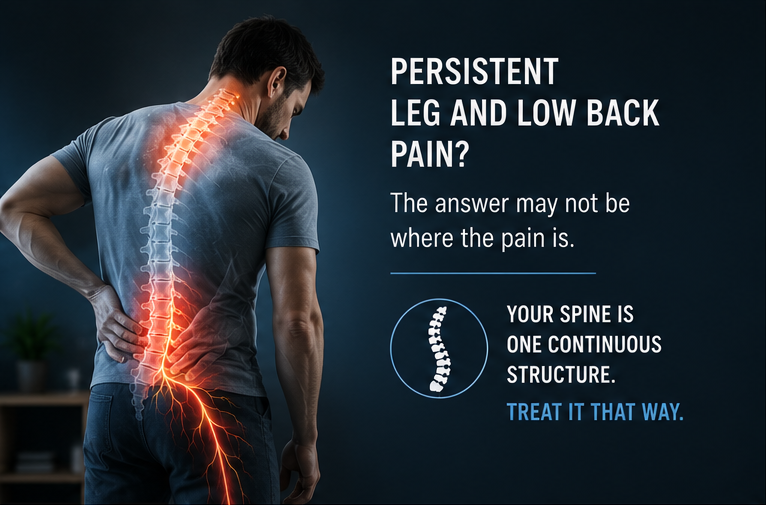
Earlier this week I had a conversation with a patient that stuck with me. They came in describing a fairly familiar picture: low back pain radiating down one leg, the kind of deep, sometimes burning discomfort that follows a nerve pattern. What made the conversation memorable was that they said they had been dealing with this for years, had tried everything directed at the low back specifically, and nothing had produced lasting relief.
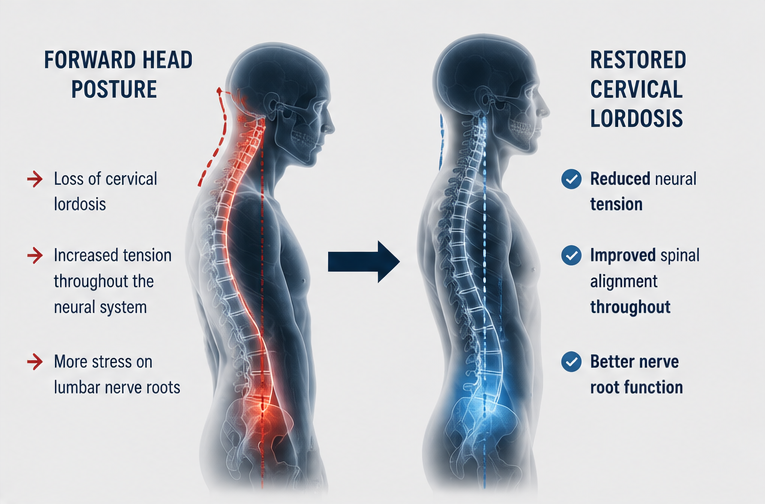
As we talked through their history and reviewed their structural findings, we discovered a significant forward shift of the head and a reduced cervical curve (see below for an example). At first glance that might seem like a completely separate problem from the lumbar complaint that brought them in. But it's actually a pattern that shows up regularly in practice and one that a 2022 randomized controlled trial published in the Journal of Clinical Medicine speaks to directly.
What that research found may change how you think about where pain comes from.
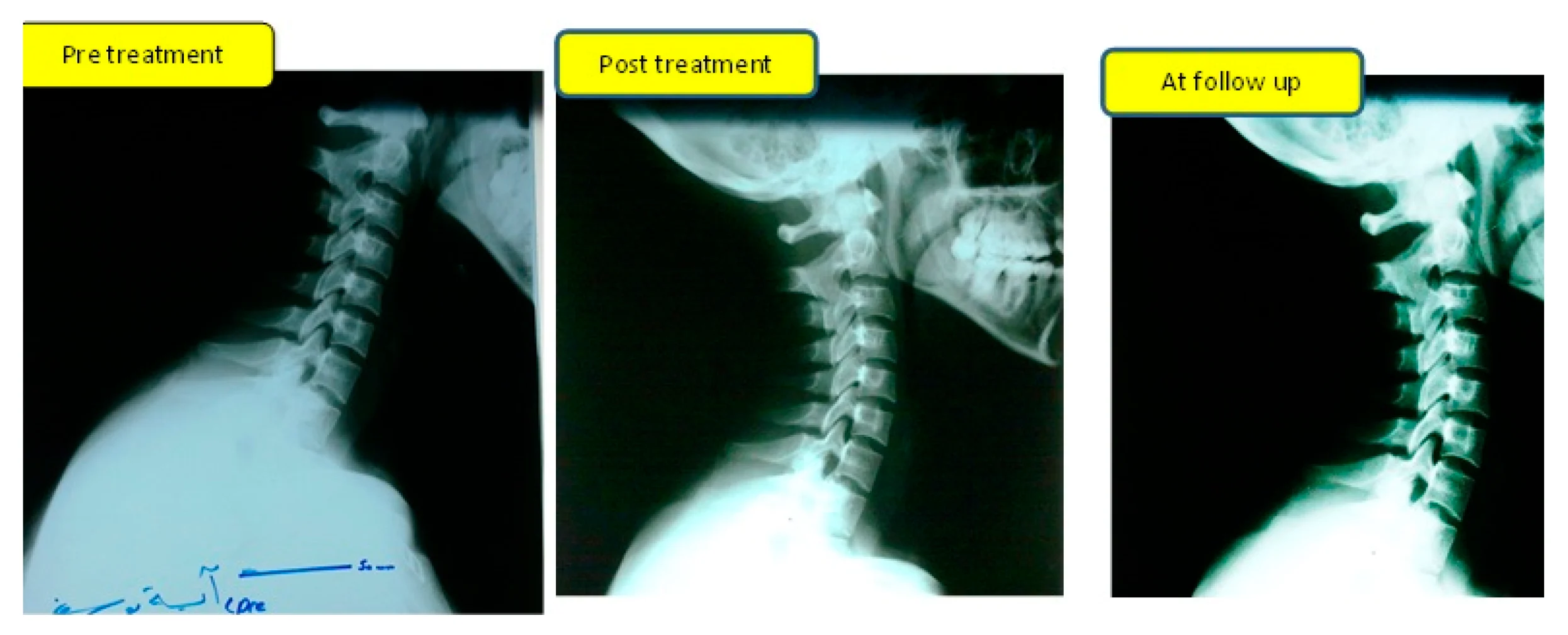
Figure 3 from Oakley et al., Journal of Clinical Medicine, 2022 (doi.org/10.3390/jcm11195768). Pre-treatment, post-treatment, and 6-month follow-up cervical X-rays demonstrating structural correction and its durability.
First: What Is Lumbosacral Radiculopathy?
Lumbosacral radiculopathy is the clinical term for what most people call sciatica (pain, numbness, tingling, or weakness that radiates from the low back down through the buttock and sometimes into one leg) and typically follows the path of a compressed or irritated nerve root. It's one of the most common and debilitating structural complaints, strongly associated with disc herniation at the L4-L5 or L5-S1 levels.
Most treatments focus exclusively on the lumbar spine, where the nerve is being compressed. What this study asked was a different and more interesting question: does the alignment of the cervical spine (their neck) affect these outcomes?
What the Researchers Did
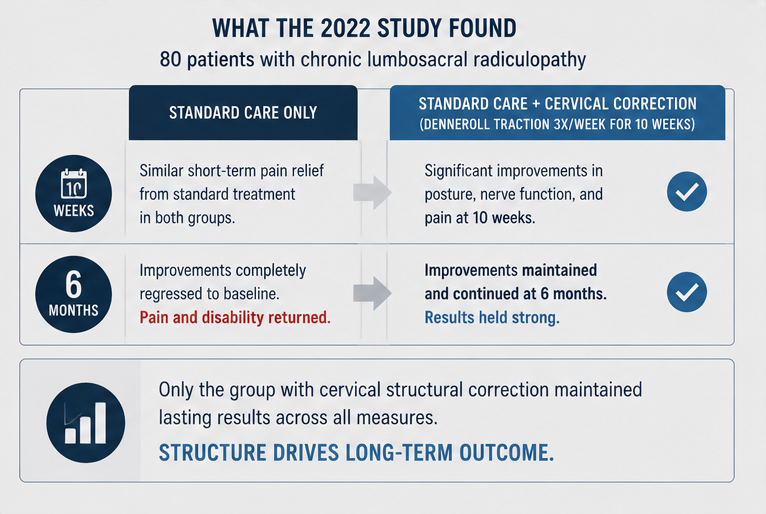
Eighty patients with confirmed chronic lumbosacral radiculopathy, all of whom also had a measurably reduced cervical curve and forward head posture, were divided into two groups. Both groups received standard pain management treatment. The study group received one additional intervention: the Denneroll cervical traction orthotic applied three times per week for ten weeks to restore the cervical lordosis and reduce forward head translation. Both groups were then followed for an additional six months with no further treatment to see whose results held.
The Results
At 10 weeks: posture and nerve function improved significantly
The group receiving cervical structural correction showed measurable improvements in cervical lordosis, forward head posture, and the full three-dimensional posture of the thoracic and lumbar spine, changes that did not occur in the control group. Remarkably, nerve function as measured by the H-reflex, a neurophysiological test of the S1 nerve root most commonly affected in lumbosacral radiculopathy, also improved significantly in the cervical correction group. Both groups showed similar short-term reductions in leg and back pain at 10 weeks, largely attributed to the standard pain treatment both received.
At 6 months: the difference became unmistakable
This is where the structural difference became undeniable. At the six-month follow-up, six months after all treatment had ended, the control group's improvements had completely regressed to their pre-treatment baseline. Their leg pain, back pain, and disability scores returned to where they started. The cervical correction group, on the other hand, maintained and in many cases continued to improve across every variable: leg pain, back pain, disability, three-dimensional posture, cervical alignment, and nerve root function. The results were statistically significant across the board.
Only the group that received cervical structural correction maintained lasting results. The group that received standard care alone did not.
The Neck Bone Is Connected to the...
The spine is one continuous structure, not a collection of isolated parts.
The nervous system runs through the entire length of the spinal column as one continuous unit. Research has demonstrated that even slight loss of the cervical curve creates measurable tension in the spinal cord and nerve roots all the way down to the cauda equina at the base of the spine. Think of the spinal cord like a garden hose running through a curved pipe, when the curve is lost, the hose straightens, and tension increases along its entire length, not just at the point of the kink. It's similar to stretching a rubber band and watching the middle section deform from the tension distributed through the whole band.
For a patient with a lumbar disc herniation already creating compression on a nerve root, adding increased neurological tension from a cervical structural abnormality compounds the problem significantly. Correcting the cervical spine does address the neck, but it also reduces tension on the entire neural system, allowing the lumbar nerve roots to decompress more effectively and structural corrections to hold.
This is the core of what we mean by Precision Structural Correction: addressing the full spinal structure rather than just the area producing symptoms. Treating only where it hurts, without addressing the structural context that created the vulnerability, is why so many people experience temporary relief that doesn't last. The study's control group demonstrated this pattern with precision.
What This Means for You
If you or someone you know has been dealing with persistent low back or leg pain, especially if previous treatments have produced only temporary relief, the answer may not be where the pain is.
The full study is published open-access in the Journal of Clinical Medicine and is available at doi.org/10.3390/jcm11195768 for anyone who wants to read it in full. If you'd like to discuss what your structural findings mean in the context of your symptoms, that conversation starts with a complimentary consultation. Call us at (412) 835-4844, visit structuralchiropit.com, or simply tap the button below to find a time that works for you.