
What Your Child's Backpack Is Doing to Their Spine and How to Fix It
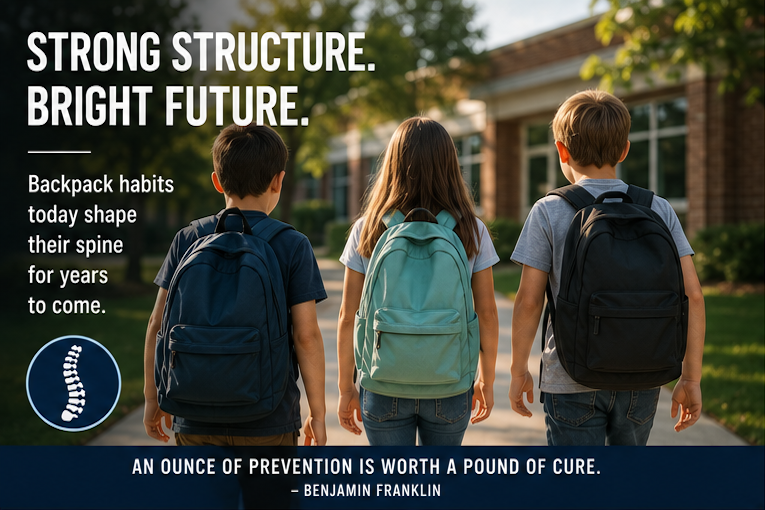
School supply lists are checked off, new shoes are broken in, and backpacks are being loaded up across the South Hills. With Bethel Park, Upper St. Clair, and Mt. Lebanon schools all heading back within the next few weeks, this is the right time to talk about something most parents ask about each year: what that backpack is doing to their child's spine every single day.
A backpack worn incorrectly or loaded too heavily creates real, measurable structural stress on a spine that is still developing. The patterns and compensations that develop during childhood and adolescence don't disappear when kids grow up. They become the structural abnormalities we work to correct in adults. As Ben Franklin once said, an ounce of prevention is worth a pound of cure.
The Weight Problem
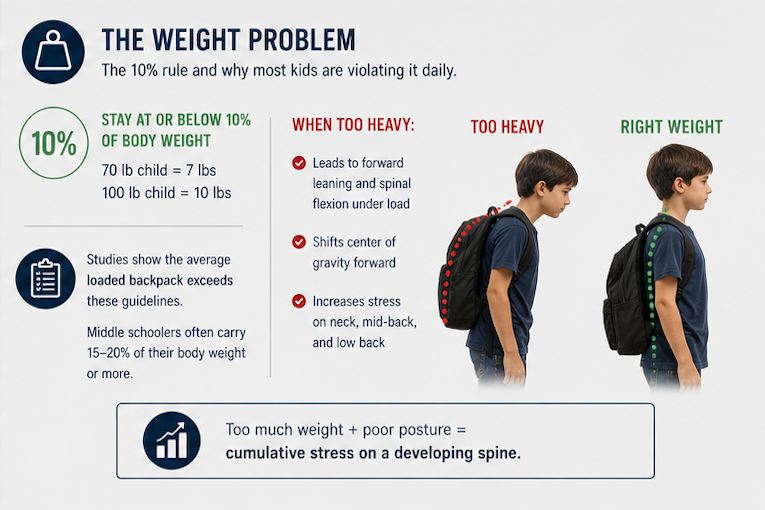
The American Chiropractic Association and most pediatric spine researchers recommend that a backpack should never exceed 10% of a child's body weight. For a 70-pound third grader, that's 7 pounds. For a 100-pound sixth grader, that's 10 pounds. Weigh your child's loaded backpack tonight. Most parents are genuinely surprised by what they find. Studies have found that the average loaded school backpack exceeds these guidelines significantly, with middle schoolers often carrying 15–20% of their body weight or more.
When a backpack is too heavy, the body compensates by leaning forward at the trunk, shifting the center of gravity and forcing the cervical and lumbar spine into flexion under load. It's the same mechanism as Anterior Head Syndrome (Forward Head Posture) from screen time, just with added weight driving it faster. Over a full school year of daily loading, that's a significant cumulative structural stress on a developing spine.
How It's Carried Matters as Much as How Heavy It Is
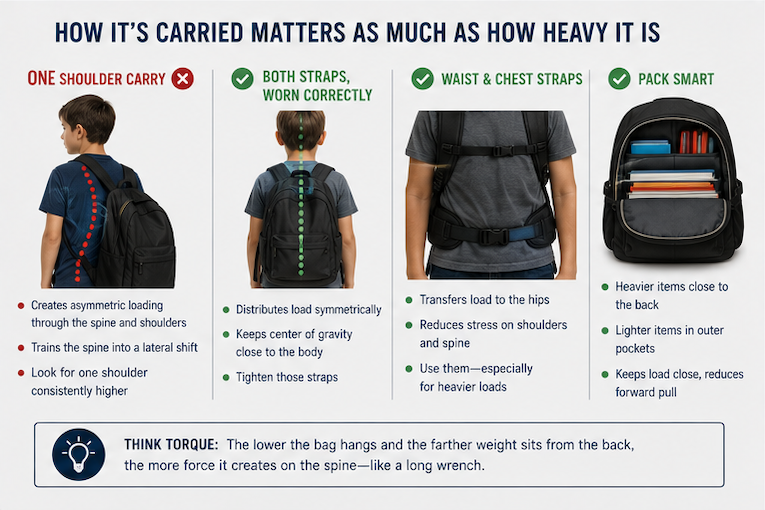
One shoulder carry
Slinging a backpack over one shoulder is the default for most kids, and it has the worst implications for a developing structure. It creates sustained, asymmetric loading through the cervical spine, shoulder, and thoracic region that actively trains the spine into a lateral shift over time. Look at your child from behind when they carry their bag. If one shoulder is visibly higher than the other, that's the compensation happening in real time.
Both straps, worn correctly
Both straps, adjusted so the bag sits high on the back rather than hanging low toward the lumbar spine, distributes the load symmetrically across both shoulders and keeps the center of gravity closer to the body. The lower the bag hangs, the greater the lever arm pulling on the lumbar spine. Think of the torque from a long wrench, a bag at mid-back versus a bag at the lower lumbar creates a significantly different structural demand. Tighten those straps.
Waist and chest straps
Most quality backpacks include a waist belt and a chest strap that most kids never use. The waist belt transfers a significant portion of the load from the shoulders and spine to the hips, which are far better equipped to carry it. For heavier loads, using these features makes a meaningful difference in the weight distribution. If your child's backpack doesn't have them, it's worth considering one that does.
Pack smart
Where weight sits inside the bag matters. Heavier items (binders, textbooks, laptops) should be packed closest to the child's back, keeping the center of gravity as close to the spine as possible. Lighter items go toward the outer pockets. A poorly organized bag with heavy items far from the back creates a greater forward moment arm, increasing the structural demand even at the same total weight.
What to Watch for in Your Child This School Year
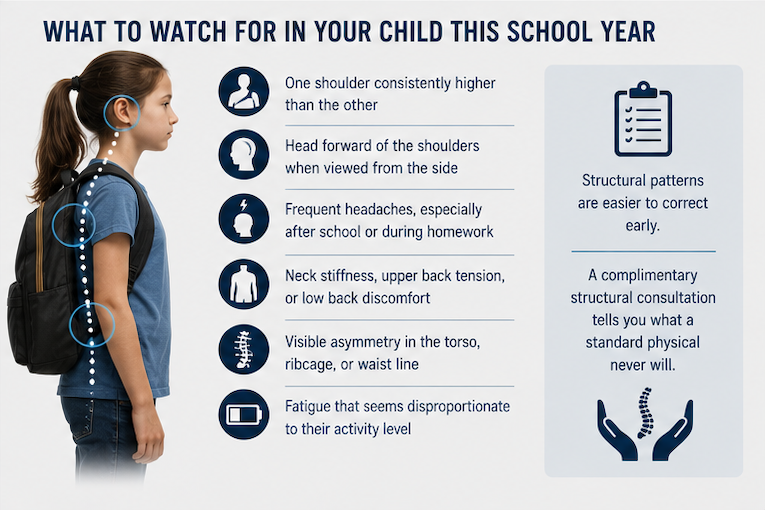
Structural patterns that develop during childhood are significantly easier to correct early than they are a decade later. The school year is one of the most important windows to pay attention to your child's posture and structural development. A few signs worth taking seriously:
One shoulder consistently higher than the other when standing or carrying their bag.
Head that sits noticeably forward of the shoulders when viewed from the side.
Frequent headaches, especially at the end of the school day or during homework.
Complaints of neck stiffness, upper back tension, or low back discomfort.
Visible asymmetry in the torso, ribcage, or waistline when standing naturally.
Fatigue that seems disproportionate to their activity level, an asymmetric structural system under chronic load becomes tiring in ways that aren't always obvious.
None of these are things to dismiss or wait on. A complimentary structural consultation for your child takes the same amount of time as a back-to-school physical, and tells you something a standard physical does not.
The Back-to-School Window
The back-to-school season is a fresh start in a lot of ways. It's also one of the best opportunities to establish structural habits early, before the cumulative load of a school year has a chance to compound. A few small changes to how your child carries their bag can make a meaningful difference over the course of a year; and if you've been wondering about their posture, this is the right time to find out.
Call us at (412) 835-4844, visit structuralchiropit.com, or tap the button below to schedule a complimentary structural consultation for your child.