
The Tale of Sir Spooky Spine: A Real Patient’s Structural Correction Results
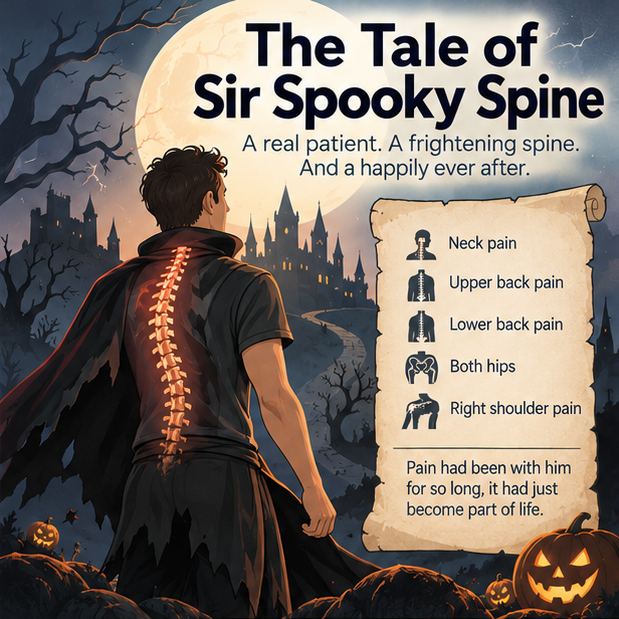
It’s the week of Halloween, and in the spirit of the season I want to share a story. It has all the makings of a good scary tale: a young man, the creeping shadow of pain, and a mystery nobody had uncovered. But unlike most Halloween stories, this one ends… with a treat! Gather around for the tale of Sir Spooky Spine.
The Tale of Sir Spooky Spine
Our patient, whom we’ll call Sir Spooky Spine, was 33 years old when he first walked through our door. On the surface he looked like any other gentleman his age, but beneath the surface… trouble was afoot.
He had pain in his neck, upper back, lower back, both hips (more on the right), and his right shoulder. That pain had been with him long enough that he had stopped thinking of it as unusual. It had simply become part of life. His outcome assessments showed the toll it was taking. His neck disability score measured 18%, where 0 is normal. His low back disability score measured 18%, where 0 is normal. His hip function sat at 85%, where 100% is normal. None of that was supernatural, but it was enough to chip away at Spooky’s daily life in ways that he finally found unacceptable.
Alas, a concerned friend referred him to our practice for a structural evaluation, and that is when the real story began.
The Horrors of the Bones Below
When we took his full-spine Precision Structural Radiographs (X-Rays) and ran the structural analysis, Sir Spooky’s findings were, in the spirit of the season… quite frightening.
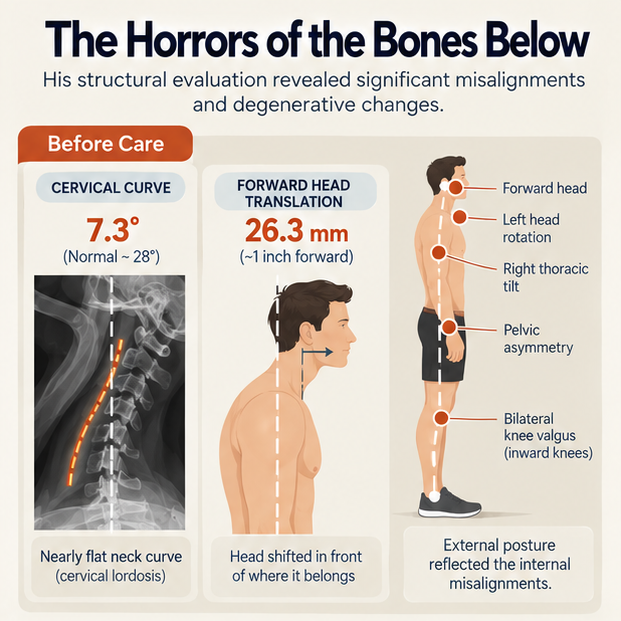
His neck curve, the cervical lordosis, was nearly flat. It measured a mere 7.3 degrees, where normal is considered about 28 degrees for his ribcage shape, also known as thoracic inlet morphology. His head had shifted forward 26.3 millimeters in front of where it belongs, roughly an inch of forward displacement from the base of the neck. At C6-C7 there was segmental instability consistent with a prior head or neck trauma. Throughout his entire spine we noted degenerative changes consistent with years of abnormal loading.
His external posture reflected all of it: forward head, left head rotation, right thoracic tilt, pelvic asymmetry, and bilateral knee valgus, meaning inward-pointing knees. The surface matched the inside. These were the structural abnormalities driving a spine whose bones had been working harder than necessary for a long, long time.
Sir Spooky Spine Winds Up With a Wonderful Treat
Three months of Precision Structural Correction later, Sir Spooky came back for his progress evaluation. New x-rays, new posture analysis, and new outcome scores. The results were as delightful as your favorite candy bar on Halloween night.
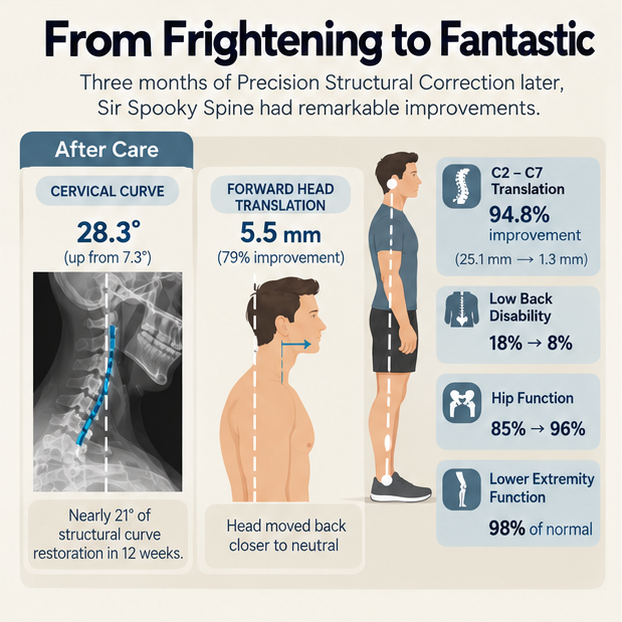
His neck curve improved from 7.3 degrees to 28.3 degrees, nearly 21 degrees of structural curve restoration in just 12 weeks. His forward head translation dropped from 26.3 mm to 5.5 mm, a 79% improvement. On the full-spine comparison films, the translation at C2-C7 reduced from 25.1 mm to just 1.3 mm, a 94.8% improvement. His low back disability score dropped from 18% to 8%. His hip function climbed from 85% to 96%. His lower extremity function reached 98% of normal.
See Sir Spooky Spine’s Correction
The measurements are nice, but a picture is worth a thousand words. The images below represent his initial evaluation and 12 week progress evaluation.
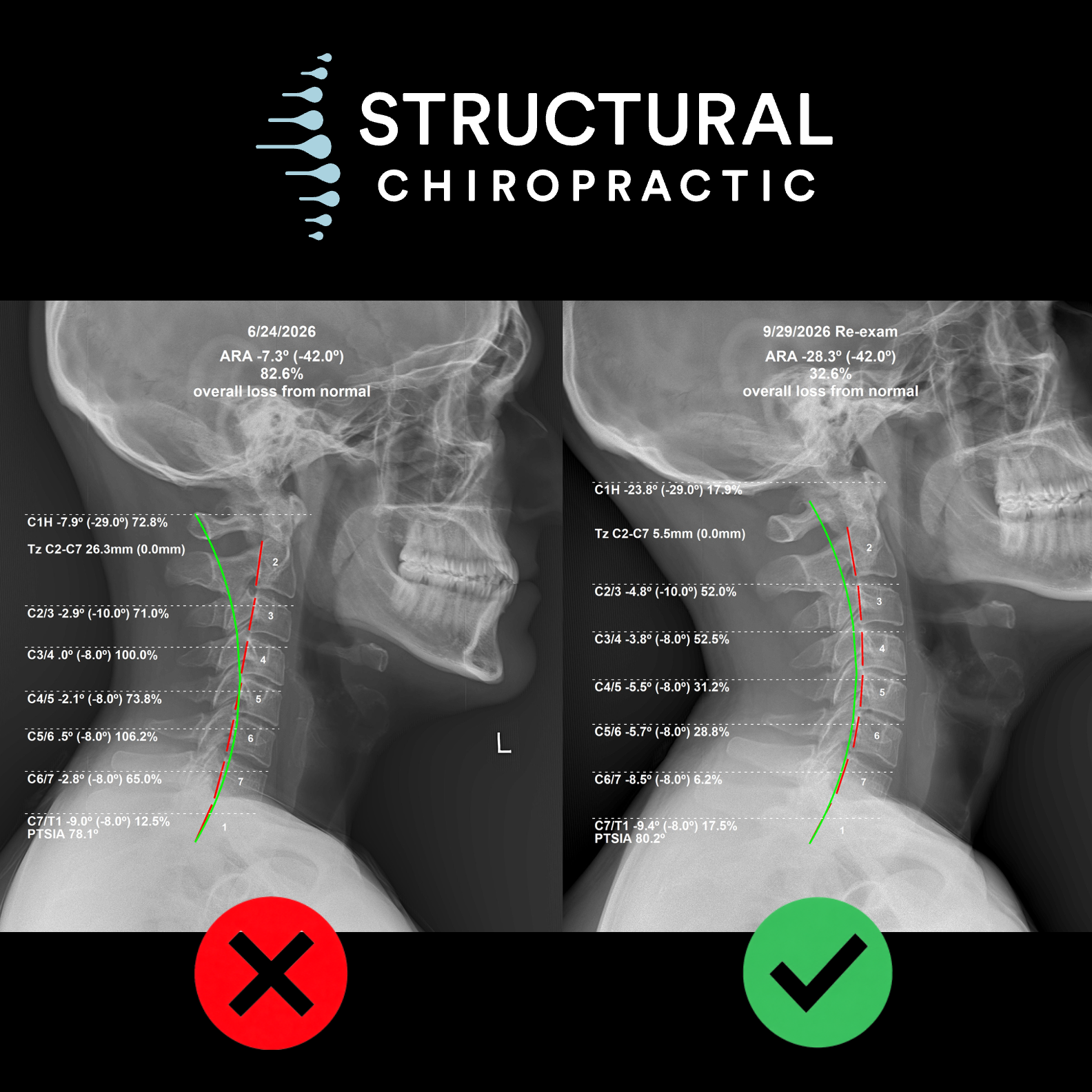
Lateral cervical x-rays before care (left) and at re-exam (right). The neck curve improved from 7.3 degrees to 28.3 degrees and forward head translation from 26.3 mm to 5.5 mm. The green line marks normal alignment and the red line marks the patient’s alignment.
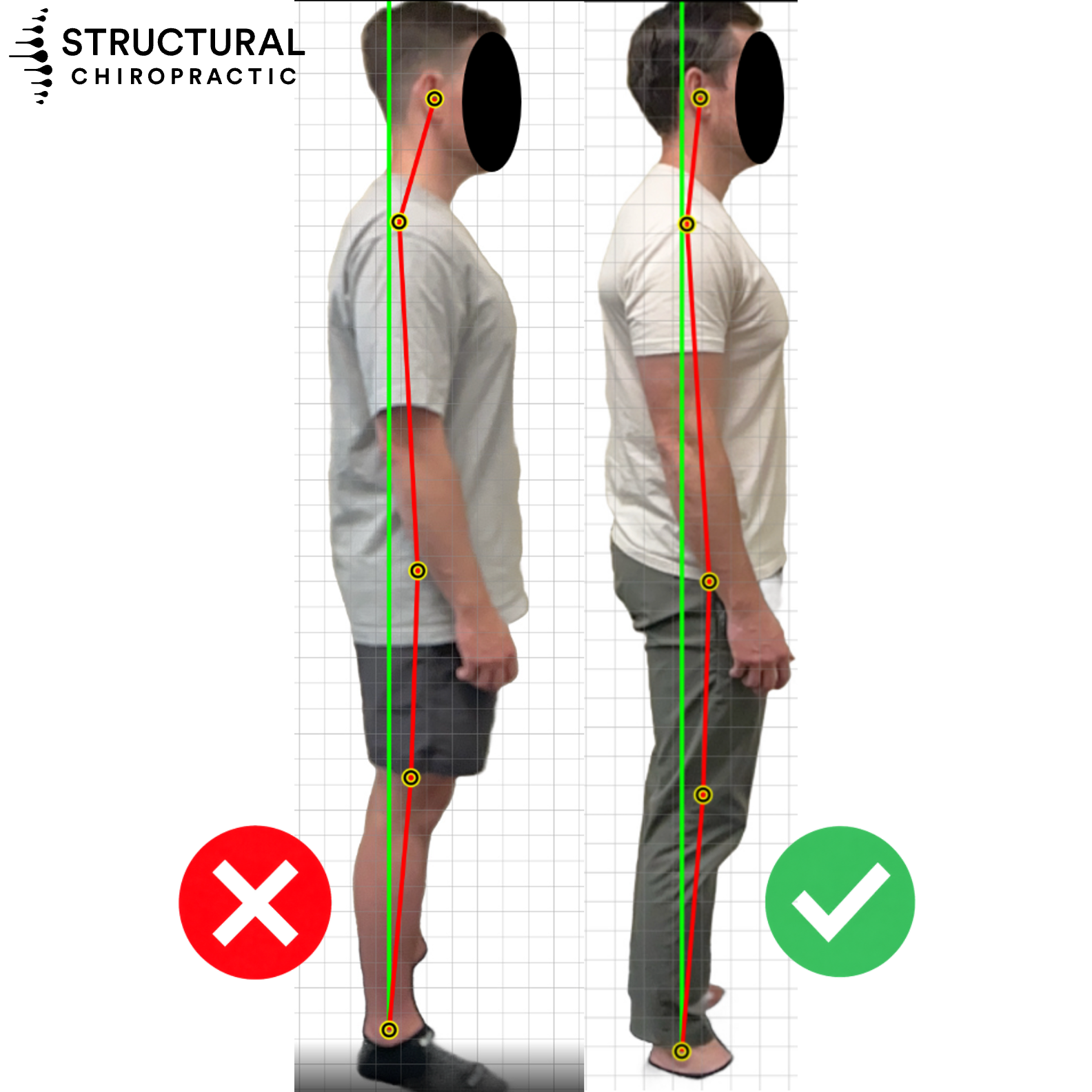
Side posture photos before care (left) and at re-exam (right). The green line is vertical and the red line follows the patient’s alignment.
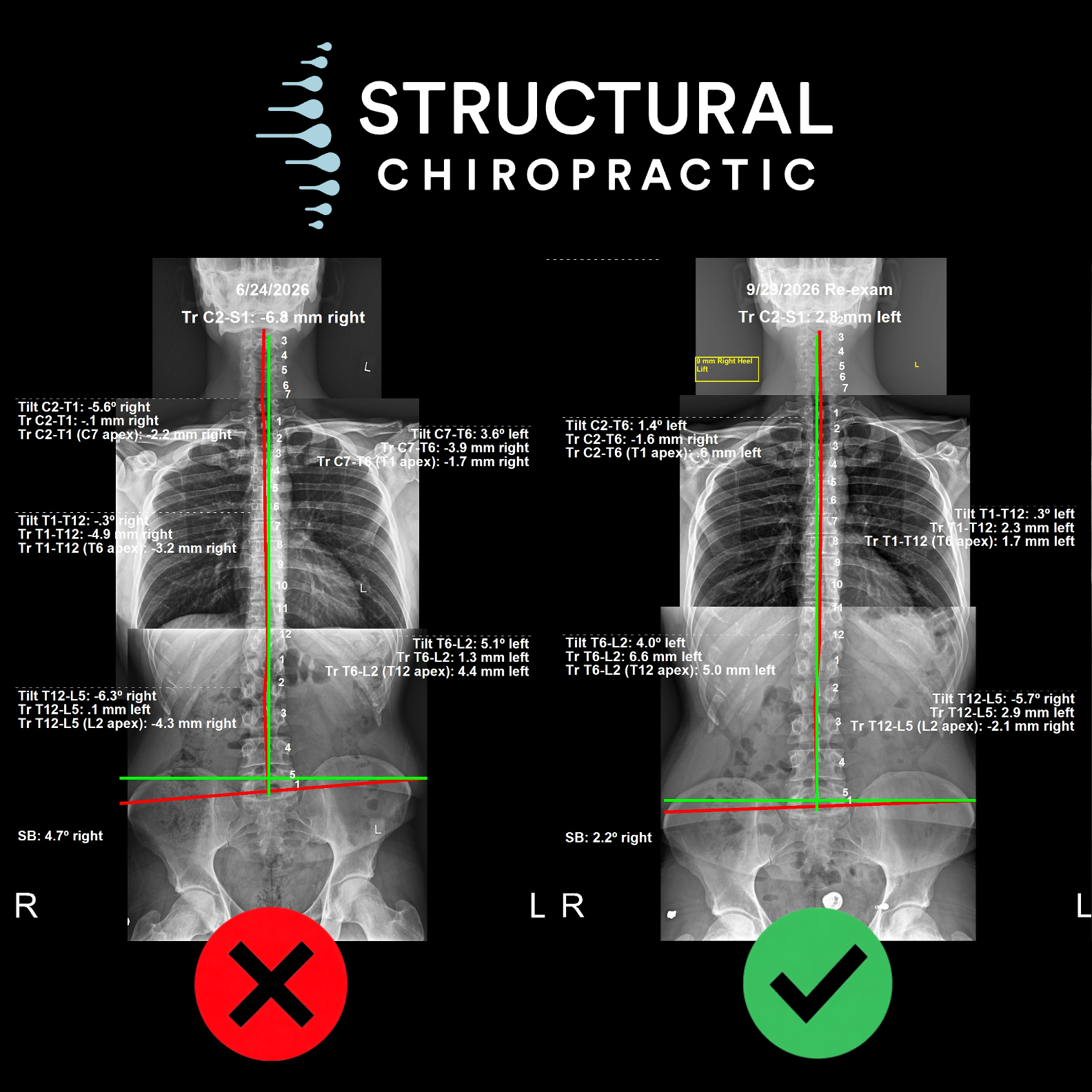
Full-spine x-rays before care (left) and at re-exam (right) with measured tilt and translation values. The re-exam film was taken with a 9 mm right heel lift.
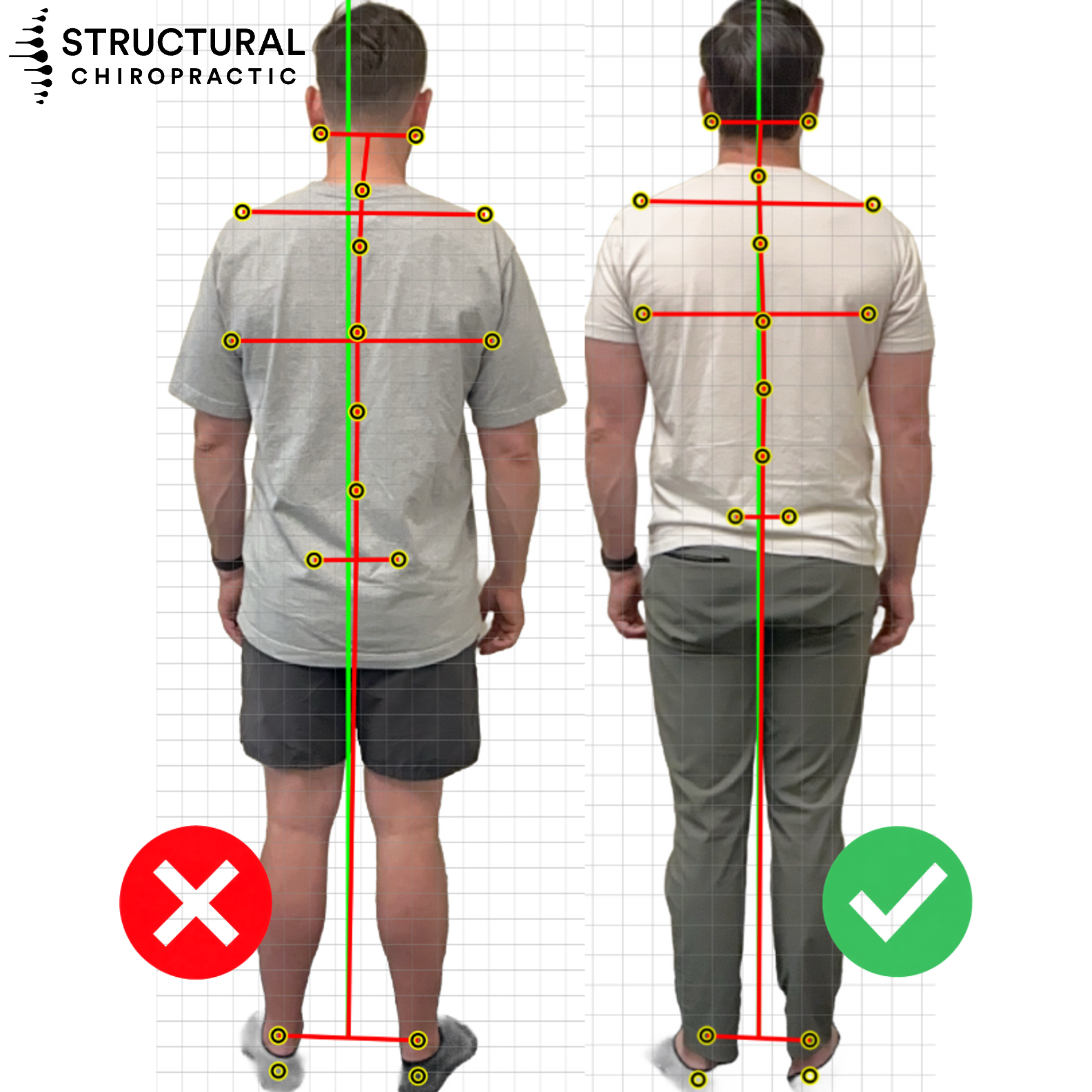
Rear posture photos before care (left) and at re-exam (right). The green line is vertical and the red line follows the patient’s alignment.
A Happily Ever After
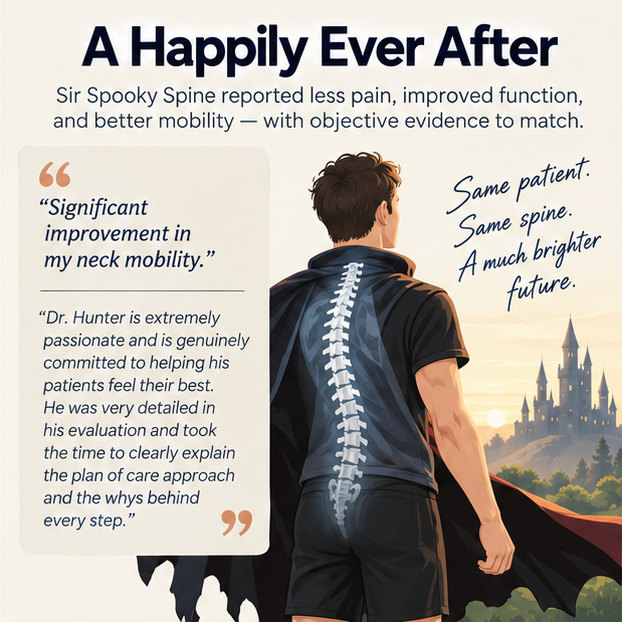
He reported reduced pain and, in his own words, “significant improvement in my neck mobility.” He also shared this about his experience: “Dr. Hunter is extremely passionate and is genuinely committed to helping his patients feel their best. He was very detailed in his evaluation and took the time to clearly explain the plan of care approach and the whys behind every step.”
For me, this was the greatest treat of all. I would like to thank Sir (Not So) Spooky Spine (Anymore) for letting us share his care results and story. This is one patient’s experience, and individual results vary, but it shows what is possible when we measure the structure, find the root cause, and correct it. I hope you enjoyed the Halloween spin.
If you have been living with pain so long that it feels like a “normal” part of life, our Complete Precision Structural Analysis (initial evaluation) can show you what is actually going on beneath the surface. Call us at (412) 835-4844 or visit structuralchiropit.com to learn more. Tap the button below to schedule your complimentary consultation.