
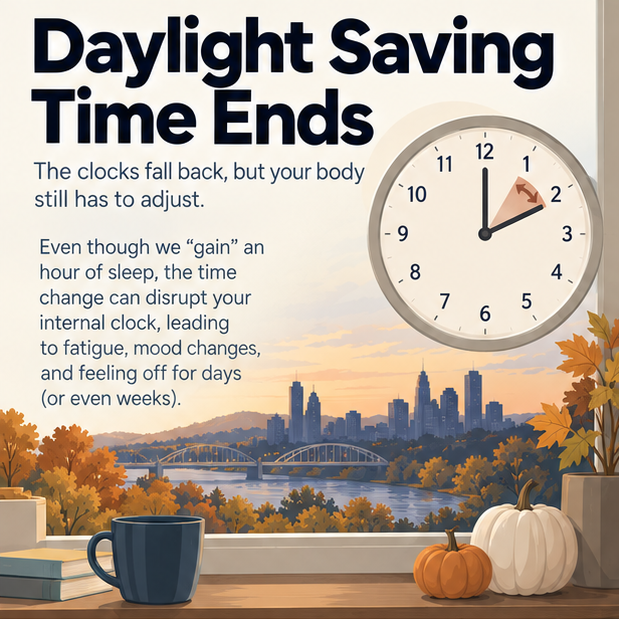
A couple of weeks ago, we discussed how the fall season brings shorter days and longer nights as we approach the winter solstice. This Sunday, November 1st, we have another important change to adapt to, because Daylight Saving Time ends. The common story is that we gain an hour of sleep when the clocks fall back. If you have ever spent the week after the time change feeling off, sluggish, or strangely moody, you already know the time change tends to create a real biological disruption. Here is why that happens and some simple steps that make the transition smoother. If you want more background on how the shortening days affect your body, start with our article on Pittsburgh’s updated fall light windows.
Your Internal Time Keeper Is Set to Light, Not a Clock
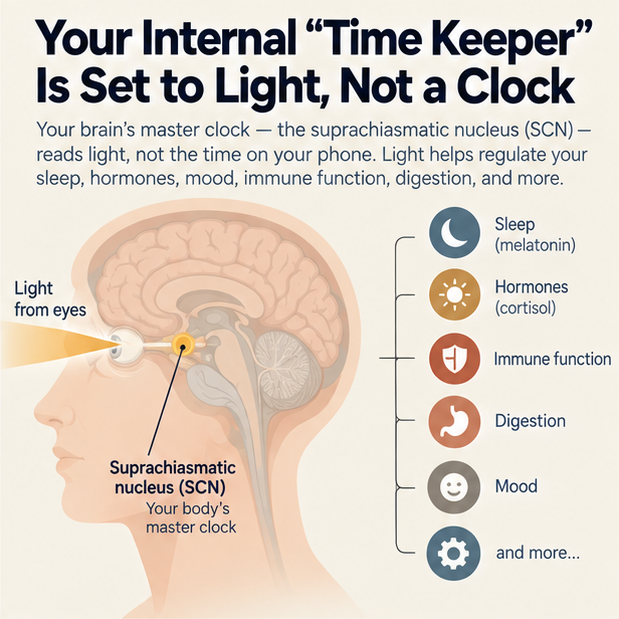
Deep inside your brain sits a tiny structure called the suprachiasmatic nucleus, or SCN, which serves as your body’s master clock. The SCN responds to light, which is why the time on your phone has little say in how you feel.
Every morning, light enters your eyes and signals this internal clock that it is daytime, time to wake up and get going. Every evening, as light fades, your brain begins releasing melatonin to signal that it is dark and time to wind down. This circadian rhythm (circa meaning around, dian meaning day) governs more than when you feel awake or tired. It directs the timing of your cortisol levels, immune function, digestion, mood, and many other bodily functions.
After Daylight Saving Time ends, the sun sets, by the clock, nearly an hour earlier than your body expects. That earlier darkness sends a wind down signal before your schedule is ready for it. Your biology thinks bedtime is approaching while the clock on the wall says you still have an evening ahead. That mismatch, even for a week or two, creates real physiological stress.
What Actually Happens the Week After
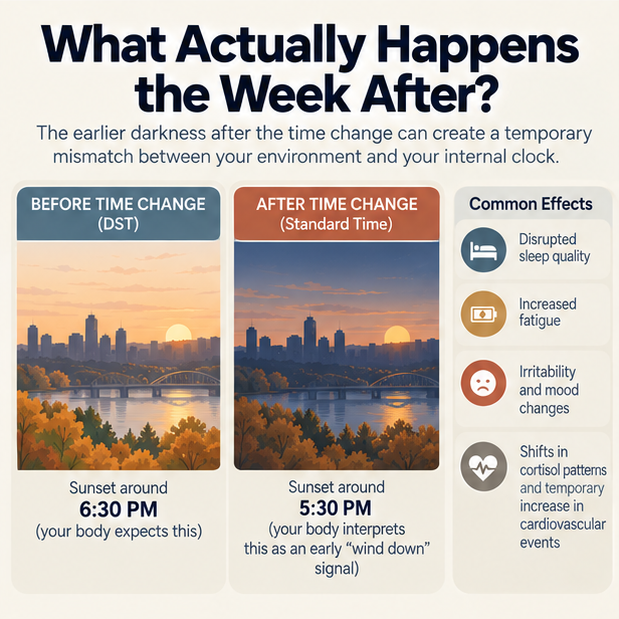
Circadian misalignment has measurable effects. Research following time change transitions has linked the adjustment period to disrupted sleep quality, increased fatigue and irritability, shifts in cortisol patterns, and even a temporary uptick in cardiovascular events in the days immediately following the change. That cardiovascular finding is seen primarily in the spring, when we move into Daylight Saving Time and lose an hour of sleep.
None of this means your body is broken. Your body is adapting to an abrupt change in its predicted schedule, and circadian researchers often describe this kind of mismatch as social jet lag. The good news is that the adjustment from Daylight Saving Time to standard time in the fall is much more forgiving than the move into Daylight Saving Time in the spring. The better news is that you can prepare for it and lighten the adjustment significantly with a few simple choices.
What You Can Do About It
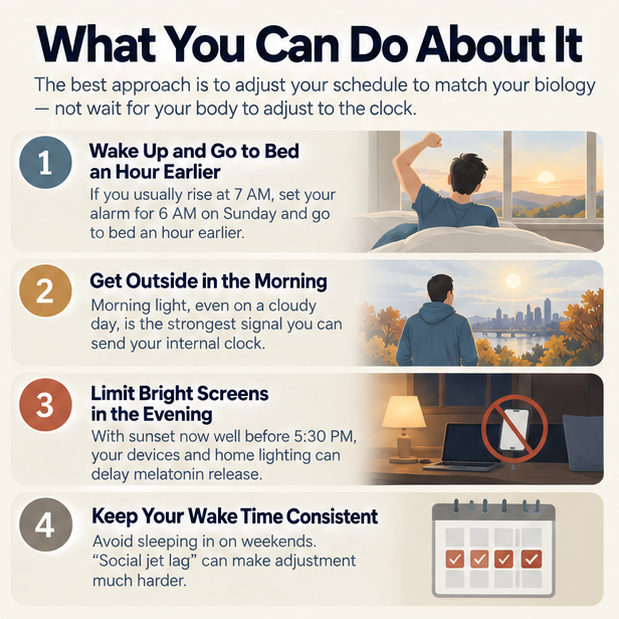
The most effective strategy is also the most counterintuitive. Instead of waiting for your body to adjust to the new clock, adjust your schedule to match your biology.
Wake up and go to bed an hour earlier. Keep your normal biological wake time, which is now one hour earlier on the clock. If you usually rise at 7 AM, set your alarm for 6 AM on Sunday and go to bed an hour earlier too. It sounds like a sacrifice, but here is why it works. As we inch toward the winter solstice on December 21st, sunrise will continue getting later each morning. Within a week or two, that later sunrise will naturally realign with your earlier wake time, and you will land right back at your normal rhythm without the fog.
Get outside in the morning. Morning light around sunrise, even on a cloudy Pittsburgh November day, is the strongest signal you can send your internal clock.
Limit bright screens in the evening. With sunset now well before 5:30 PM, your home lighting and devices become the dominant light source earlier than usual, and they can delay melatonin release when you need it most. Home lighting strategies are a topic we will cover in a future article.
Keep your wake time consistent. Sleeping in on Saturday and Sunday creates its own version of social jet lag and can make your natural adjustment to the time change much harder.
A well-functioning nervous system handles circadian stress better than one that is already under load. Quality sleep, healthy nervous system tone, and structural alignment are deeply interconnected. If you have been waking up unrefreshed or carrying tension you cannot shake, this is a good week to have your body’s foundation assessed. A structural abnormality can keep your nervous system working harder than it should (see the “Garden Hose” Effect), and a complimentary consultation is a great place to start.
Call us at (412) 835-4844 or visit structuralchiropit.com to learn more. Tap the button below to schedule your complimentary consultation.